12 kW vs 20 kW Fiber Laser: Which One Should You Buy?
Table of Contents
- Key Takeaways
- Why does laser power matter for metal cutting?
- 12 kW fiber laser: what it handles best
- 20 kW fiber laser: when you need more
- 12 kW vs 20 kW: quick comparison
- Choosing based on your industry
- Cost and ROI considerations
- Why does MAMMOTH fit both needs?
- Bottom line
- Frequently asked questions
Key Takeaways
- A 12 kW fiber laser handles most PEB, structural steel, and general fabrication jobs at a lower running cost.
- A 20 kW machine cuts thick plate faster, which suits high-volume and heavy engineering setups.
- A PEB laser cutting machine supplier India manufacturers rely on should offer both power tiers, not push one by default.
- Cutting bed size matters almost as much as kilowatts once you're working with large plates.
Ask a CNC fiber laser machine manufacturer India businesses actually buy from, and the power question usually settles into one line: 12 kW covers most structural steel and PEB fabrication work, 20 kW is for shops running thick plates all day, every day. Which one is right depends on what you're cutting, how many hours a day you run the machine, and how tight your delivery timelines are. Here's how to work that out for your own shop.
Why does laser power matter for metal cutting?
Power decides two things: how fast a machine cuts and how thick a plate it can handle without leaving a rough edge. Underpowered lasers slow down on thick steel and leave more finishing work for someone else down the line. Overpowered lasers running on a thin sheet just burn extra electricity for no real gain in cut quality.
So the goal isn't the biggest number on the spec sheet. It's matching the laser to whatever you cut most often, week in and week out. Buyers who skip this step tend to either overpay for capacity they never use or undersell their own production and get stuck waiting on cuts.
12 kW fiber laser: what it handles best
For most fabrication businesses, including PEB manufacturers and structural steel processors, 12 kW is the workhorse option. It's fast enough, precise enough, and doesn't run up your power bill.
What it handles well:
- Mild steel plates up to roughly 40-50 mm
- Base plates, gusset plates, connection brackets, and similar structural components
- Long structural members that need a clean, straight edge
- Continuous daily runs without excessive power draw
However, a lot of shops find that 12 kW covers well over 80% of what they actually cut. It also uses noticeably less power than the higher-capacity machines, which adds up over a full year of running. If you're stepping up from an older or lower-power system, 12 kW is usually the realistic next move rather than jumping straight to the top tier.
20 kW fiber laser: when you need more
A 20 kW laser exists for one reason: shops that cut very thick plates or need to cut fast enough to keep a high-volume line moving. It's not a machine every fabricator needs, but where it fits, it changes what a shop can take on.
Where the extra power pays off:
- Plate beyond 50 mm, which shows up a lot in large industrial fabrication
- Production lines where cutting time directly limits daily output
- Automotive component work that needs high throughput
- Multi-shift operations running thick material continuously
Therefore, if your order book leans heavily on heavy-gauge steel and your customers aren't flexible on deadlines, 20 kW usually pays for the jump through time saved alone.
12 kW vs 20 kW: quick comparison
| Factor | 12 kW Fiber Laser | 20 kW Fiber Laser |
|---|---|---|
| Ideal plate thickness | Up to ~40-50 mm | 50 mm and above |
| Best suited for | PEB, structural steel, general fabrication | Heavy industrial, automotive, high-volume plants |
| Cutting speed on thick plates | Good | Faster |
| Power consumption | Lower | Higher |
| Upfront investment | Lower | Higher |
| Typical use case | Daily structural fabrication | Continuous heavy-duty production |
Choosing based on your industry
Different industries tend to land on different power levels, but it's worth checking that against what your shop actually does rather than assuming.
PEB and structural steel fabricators usually get by fine on 12 kW for primary frames, secondary members, and connection plates. This is also where most people searching for a CNC laser cutting machine manufacturer in Gujarat end up, since Gujarat's industrial belt has a dense cluster of structural steel and PEB units doing this exact type of work.
Heavy engineering and automotive component manufacturers more often need 20 kW, simply because their material runs thicker and their targets are higher. If your daily numbers depend on cutting hundreds of thick components without the line slowing down, that extra power is doing real work.
One thing worth being clear about: 12 kW isn't automatically "the PEB machine," and 20 kW isn't automatically "the machine for everyone else." A number of businesses that work with large parts take full advantage of a 20 kW laser machine, yet some industries working with plates of medium thickness may achieve the desired results with a 12 kW device. A reputable PEB laser cutting machine supplier India will help you choose the right machine based on material thickness, volume of production, and purpose; you should not base your choice on your industry.
Cost and ROI considerations
A fiber laser is a long-term purchase, so the sticker price is only part of the calculation.
- Energy costs: a 20 kW machine draws more power, and that adds up fast across multiple shifts.
- Maintenance: higher-power systems generally need more attention to keep cut quality consistent.
- Speed gains: on thick plate, 20 kW can cut processing time enough to offset its higher running cost.
- Growth plans: 12 kW suits steady, moderate growth; 20 kW makes more sense if you're expecting a sharp jump in volume.
A quick way to check where you land: look at your average plate thickness and your monthly cutting hours. If most of your work sits comfortably inside 12 kW's range, spending more on 20 kW usually doesn't move your bottom line. If thick-plate orders are becoming a bigger share of your business, the higher machine often pays itself back faster than people expect.
Why does MAMMOTH fit both needs?
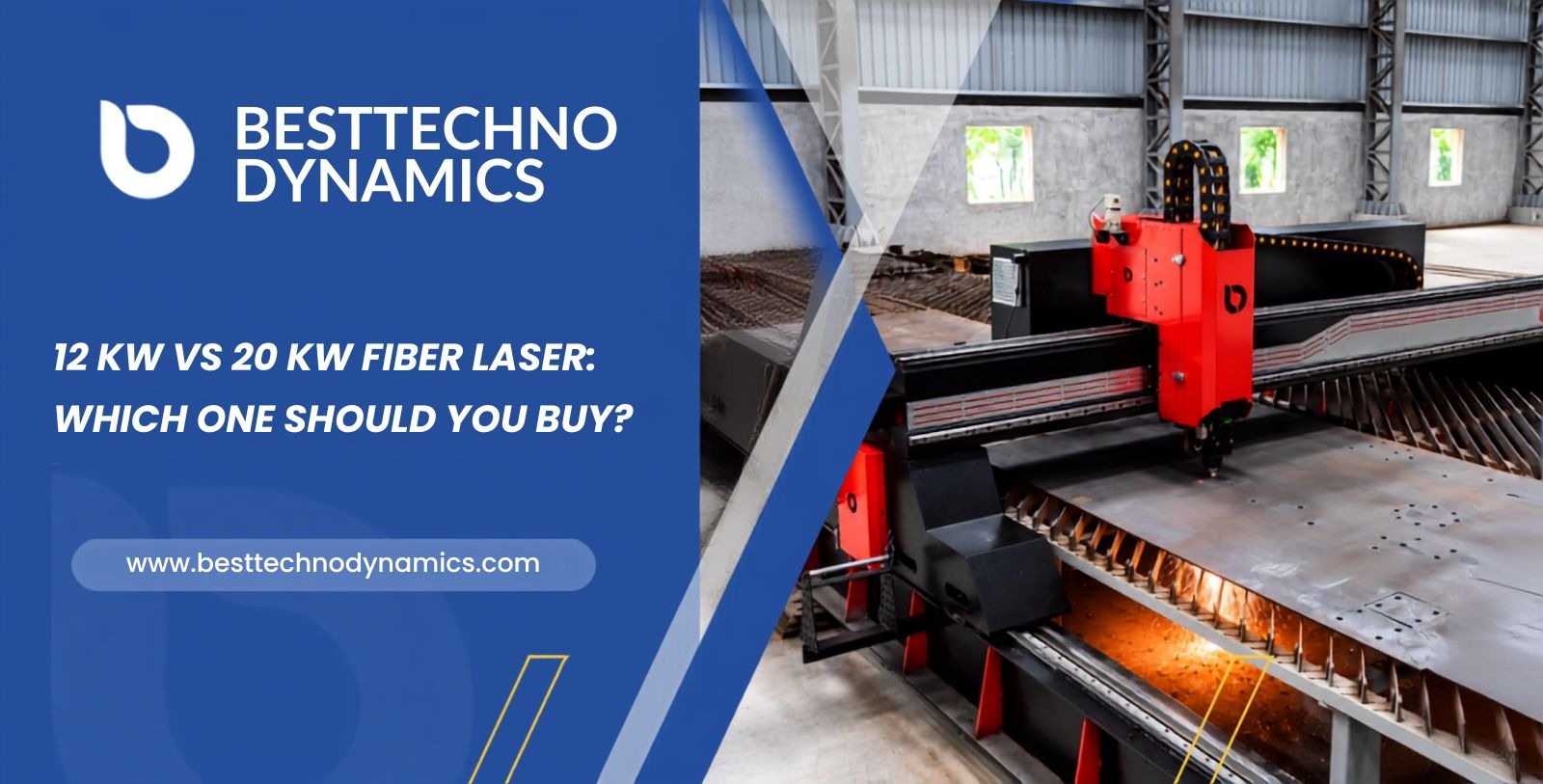
Besttechno Dynamics built the MAMMOTH series so fabricators wouldn't have to force their production into a single fixed spec. The MAMMOTH CNC Fiber Laser Cutting Machine comes with a 12 kW fiber laser source and a 3100 mm × 12500 mm cutting bed, built for PEB, structural steel, and heavy industrial work.
Moreover, that bed size matters almost as much as the power rating. A larger cutting area means long structural members and big plates go through in one setup, which cuts down on loading time and handling. Shops that need more throughput on thicker material can move up to Besttechno Dynamics' higher-power configurations, which use the same large-bed approach.
Whether your work leans toward standard PEB components or heavier industrial plates, a CNC fiber laser machine manufacturer India fabricators already trust, like Besttechno Dynamics, can walk you through which power tier actually fits your line rather than defaulting to whatever's biggest.
Bottom line
The selection of the laser cutting machine is based on the requirements of production, and you can choose between 12kW and 20kW laser cutting machines. For PEB, structural steel or general fabrication, a 12 kW machine is ideal and will be more economical to operate. A 20 kW machine is more productive and faster cutter for heavy duty cutting and high volume production.
Not sure which machine is right for your business? With years of experience, we know the ideal machine for each customer's particular application requirements, and can recommend a laser cutting machine from the MAMMOTH family that fits their material thickness, production volume and business needs. Call us now to get a specialist suggestion and a custom-made machine fit.
Frequently asked questions
Yes for most PEB components. Base plates, gusset plates, structural frames all cut true at 12 kW and it continues to run at a lower cost.
Where plates over 50mm in thickness are frequently used, or where the output of 12kW isn't enough for your order volume over several shifts.
No. Quality is provided by the matching of power and thickness of materials. When power has to do with thin skin, it can be a liability to precision, and an unnecessary energy expenditure.
The power consumption of the 12 kW fibre laser is lower, and the costs of the daily operation are also lower. This is its primary advantage for doing normal structural and PEB manufacturing.
The 12 kW and 20 kW both have a very good thickness range. The gap becomes noticeable at about 50 mm after which 20 kW is pulling ahead on speed.
For long structural members, find at least 3100mm x 12500mm. It helps reduce handling time and maximize the use of plates fed.
Seldom, unless thick plate work represents a bulk of your orders. A 12 kW system is more suitable to most smaller shops, as it will deliver a better return.
Gujarat has a well established base of manufacturers of structural steel and PEB work. Before making a decision, check the size of the bed, power options, and after-sales services.