
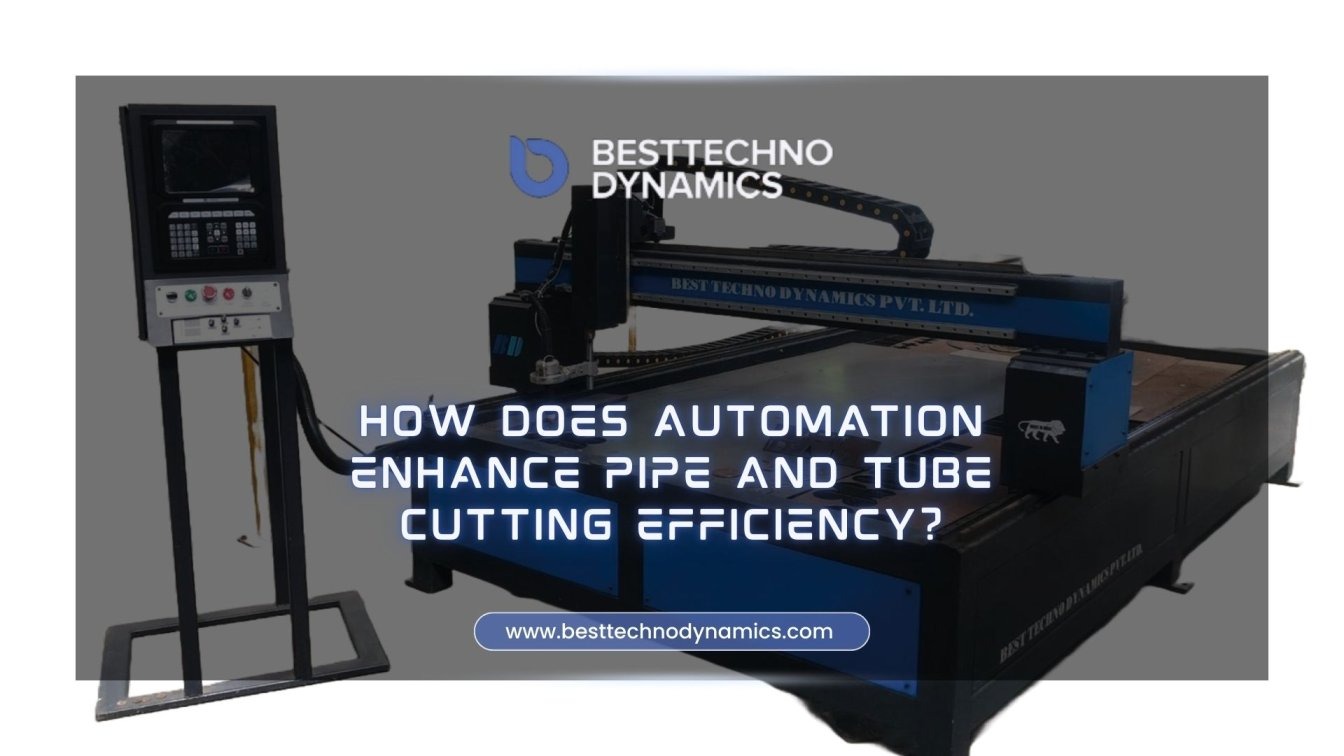
How Does Automation Enhance Pipe and Tube Cutting Efficiency?
Table of Contents
Key takeaways Why does automation matter in pipe and tube cutting? Speed and accuracy improvements with automated systems Cost savings and material control Consistent quality and safer work environment Conclusion Frequently Asked QuestionsKey takeaways
- Automation enhances cutting speed while maintaining a high level of accuracy.
- Automated systems reduce material waste and help control overall production costs.
- High-quality output is consistently maintained, even in mass production.
- Automation improves workplace safety while increasing manufacturing efficiency.
Automation enhances efficiency in the cutting of pipes and tubes through faster cutting, greater accuracy, uniformity, less wastage, and safer and more reliable production processes. In the modern manufacturing environment that is fast-paced, organizations desire quicker work with improved outcomes. Cutting of pipes and tubes is an essential process in most industries, and even a minor delay may impact the entire production line. It is where automation comes in.
However, by using high-tech tools such as a CNC fiber laser pipe profile cutting machine, companies are able to save on manual labor and make a cleaner and more precise cut. Hence, automation is not a luxury anymore; it is an intelligent production decision. Efficiency is not just about speed. It is also concerning accuracy, safety, and repeat results. Automated cutting systems assist manufacturers to cope with complicated shapes of pipes with ease. Consequently, the process of production becomes easier and more predictable.
Why does automation matter in pipe and tube cutting?
Hand cutting of pipes and tubes is time consuming and heavily dependent on worker skill. While skilled labor is valuable, it cannot match the speed and repeat accuracy of machines. Automation solves this challenge by performing repetitive tasks consistently without fatigue.
A CNC pipe profile cutting machine operates on programmed commands. Once the design is set, the machine repeats the same operation every time, significantly reducing errors caused by manual measurement or incorrect cutting.
- Faster cuts with minimal interruptions.
- Reduced dependence on manual processing.
- Smooth transition from design to final cut.
- Lower production delays.
Moreover, automated systems allow quick switching between cutting patterns. This flexibility helps manufacturers handle diverse project requirements efficiently without long setup times.
Speed and accuracy improvements with automated systems
The greatest advantages of automation are speed and accuracy. Conventional cutting methods usually involve marking, measuring, and repeated checking, which slows down production. Automated solutions, on the other hand, are driven by digital designs that streamline the entire cutting process.
A fiber laser cutting machine uses concentrated laser energy to cut pipes quickly and cleanly. The laser follows a precisely programmed path, producing smooth edges and accurate angles while reducing rework and overall completion time.
- Smooth and clean cut surfaces.
- Exact and repeatable dimensions every time.
- Easy handling of complex pipe shapes.
- Minimal errors in high-volume production.
Faster cutting does not mean compromised quality. Automation improves both speed and precision simultaneously, achieving results that are difficult to match with manual methods.
Cost savings and material control
Although automation may seem costly in the short term, it delivers significant long-term savings. One key reason is improved material utilization. Manual cutting often leads to waste due to measurement errors or inaccurate cuts, whereas automated systems greatly reduce these losses.
With advanced solutions from CNC fiber laser cutting machine manufacturers, cutting paths can be planned more efficiently. The system optimizes each cut to maximize material usage, minimizing scrap and lowering overall production costs.
- Reduced material waste.
- Lower labor expenses.
- Fewer rejected or reworked parts.
- More efficient use of production time.
Additionally, automated machines can operate for extended hours without breaks. This increases output using the same resources and significantly improves overall profitability.
Consistent quality and safer work environment
Consistency is critical in industrial production, as customers expect the same quality in every batch. Automation ensures that each pipe or tube is cut uniformly, regardless of size, delivering reliable and repeatable results.
Automated cutting also improves workplace safety. During manual cutting, workers are exposed to sharp tools, heat, and heavy materials. Automation reduces direct human contact with these hazards, lowering the risk of injuries and allowing workers to focus on monitoring and quality checks instead of dangerous tasks.
- Stable and consistent cutting across every batch.
- Reduced human involvement in handling heavy pipes.
- Lower risk of workplace accidents.
- Greater focus on quality control and management.
A safer work environment boosts employee confidence and productivity, further improving overall operational efficiency.
Conclusion
The automation has transformed the process of pipe and tube cutting. It makes it a single smooth process that is fast, accurate, cost-controlled, and safe. With a CNC fiber laser pipe profile cutting machine, industries can now easily control the quality of cutting as well as the flow of production.
However, manual solutions still exist, but it is obvious that automated ones are more efficient and have a greater value in the long run. Such systems enable manufacturers to be confident in fulfilling the current production needs. Hence, automation is not merely enhancing the cutting of pipes and tubes- it is defining the future of intelligent and efficient production.
Frequently Asked Questions
-
How does automation improve pipe and tube cutting efficiency?
Automation increases cutting speed, accuracy, repeatability, reduces errors, and improves overall production efficiency. -
Is automated pipe cutting suitable for complex shapes?
Yes, automation easily handles complex pipe shapes while delivering accurate and consistent cuts every time. -
Does automation reduce material waste in pipe cutting?
Automated systems optimize cutting paths and reduce measurement errors, significantly minimizing raw material waste. -
Is automated pipe and tube cutting safer than manual methods?
Yes, automation reduces direct human contact with cutting operations, lowers injury risks, and creates a safer workplace.