
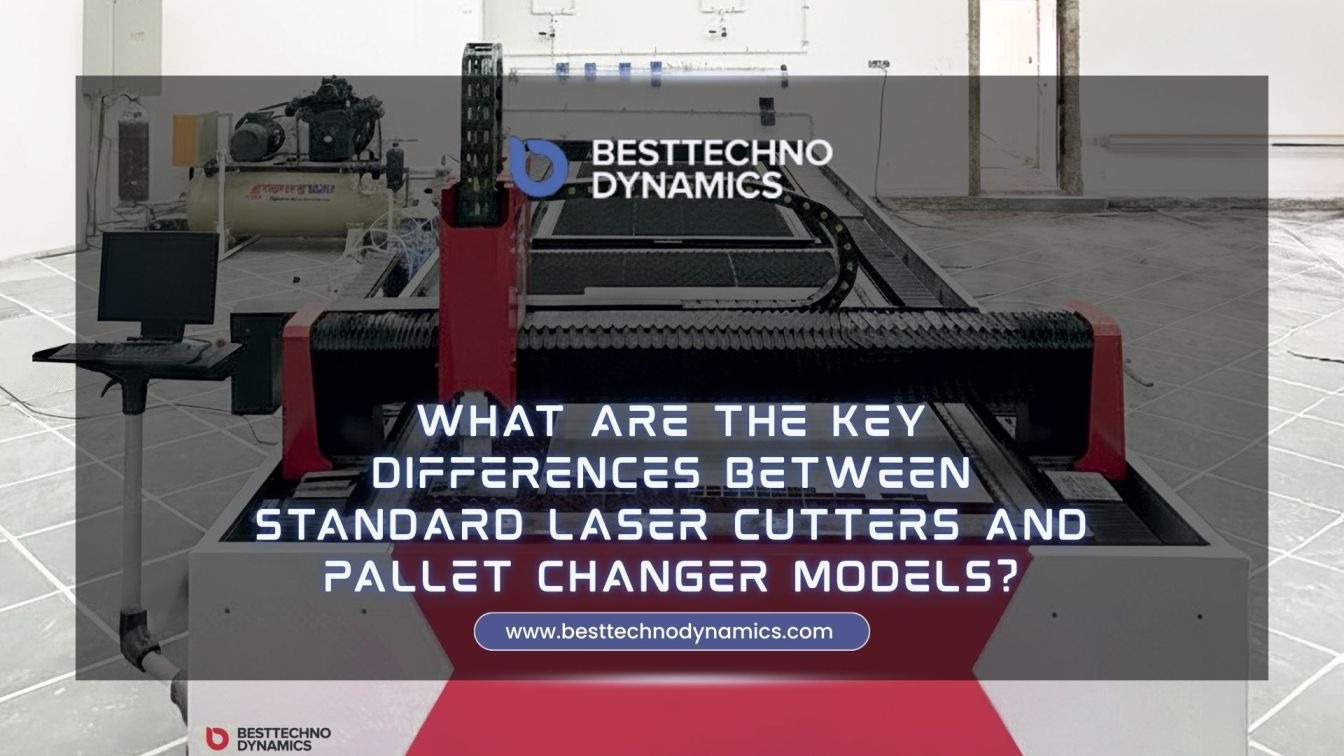
What Are the Key Differences Between Standard Laser Cutters and Pallet Changer Models?
Table of Contents
Summary Understanding standard laser cutters Exploring pallet changer laser cutters Key differences between standard and pallet changer models Which model should you choose? Conclusion Frequently asked questionsSummary
- A standard laser cutter is suitable for low-volume production, while pallet-changers improve productivity.
- Pallet changer laser cutting machines minimize downtime because the pallets are automated.
- The selection of a fiber laser cutting machine is based on the requirements and budget.
- The trusted CNC fiber laser cutting machine suppliers for Indian customers ensure improved functionality and services.
The technology of laser cutting has transformed contemporary production. In metal fabrication, automotive and industrial production, the selection of the appropriate laser cutting machine is important in terms of efficiency and quality. The most common ones among the available options include standard laser cutters and pallet changer models. Knowing their differences can save time and money and enable you to make the correct investment to benefit your business.
This blog will discuss the technology of fiber laser cutting machines and explore the differences between the standard models and pallet changer models. Moreover, you will get a clear idea of what machine is appropriate for your production.
Understanding standard laser cutters
Small and medium scale operations use the traditional laser cutters. They are specifically made to slice sheets of metal or other substances with precision with the use of a laser.
Standard Laser Cutters have features:
- Single worktable for loading and cutting
- Placing materials manually or semi-automatically.
- Applicable to smaller batch production.
- Less initial investment than pallet changer models.
The machines suit well in businesses that do not require high production levels. A CNC fiber laser cutting machine can give precise cuts; however, it might need more operator care and time to load and offload materials.
Exploring pallet changer laser cutters
The pallet changer laser cutters are modernized machines that are more efficient. They are equipped with two or more tables (pallets) on which one sheet can be cut as another one is loaded or unloaded.
Pallet Changer Models Features:
- Constant operation on dual or multiple pallets.
- Material handling that is fully automated.
- Less time between cuts.
- Best suited for high-volume production.
This arrangement will make sure that production does not halt due to changes in materials. Additionally, the pallet changer models would best suit the operations that need quick turnaround and high output. They are a bit costly but provide a lot of time and productivity.
Key differences between standard and pallet changer models
The differences allow you to select the appropriate machine to use in your business. The following are the key factors to be considered:
1. Production Efficiency
Standard Laser Cutters: Ideal in low- to medium-volume production. The cutting is halted each time a sheet is loaded.
Pallet Changer Models: This will enable one pallet to be loaded and the other one to be cutting. This decreases downtimes and enhances throughput.
2. Automation Level
Standard: Majorly manual or semi-automatic. Each cycle requires operator intervention.
Pallet Changer: This is extremely automated and has two pallets. The machine will run continuously, and the operators can attend to other activities.
3. Cost Considerations
Standard: Reduced start-up capital. Perfect in startups or in small workshops.
Pallet Changer: It is more expensive initially, but it recovers sooner in case the production is high because it saves time and expenses on labor.
4. Maintenance and Downtime
Standard: Routine maintenance with increased material handling stops.
Pallet Changer: It has a little bit of complicated maintenance but has a reduced downtime because it is an automated material change.
Comparison Table:
| Feature | Standard Laser Cutter | Pallet Changer Laser Cutter |
|---|---|---|
| Production Speed | Moderate | High |
| Automation Level | Low to Medium | High |
| Initial Cost | Lower | Higher |
| Suitable For | Small batch production | Large batch/high volume |
| Downtime | Frequent | Minimal |
Which model should you choose?
The decision will be based on your needs of production:
- Standard laser cutters would be the best option in case you are a small business, require less investment, and manufacture low to medium volume.
- Use Pallet Changer Models when you need large volumes and automation and when you need to reduce downtime.
Additionally, check with a reputable CNC fiber laser cutting machine manufacturer or laser cutting machine manufacturers in India that would offer after-sales services and spare parts. This provides a smooth-running machine and a long life span.
Conclusion
The advantages of both the standard laser cutters and the pallet changer models are that they have. Pallet changer models are best suited to large production with high volume, whereas standard laser cutters are suitable in small workshops with moderate production. However, knowing these differences will help you choose a machine that will increase productivity and minimize downtimes, as well as provide accurate results over time.
The right fiber laser cutting machine or consulting a reputable CNC Fiber Laser Cutting machine manufacturer can make a big difference in efficiency and profitability. Therefore, it is important to consider your production requirements and then make a decision.
Frequently asked questions
What is the main difference between standard laser cutters and pallet changer models?
Standard cutters interrupt the material change, whereas pallet changers permit continuous cutting of automated pallets.
Which machine is better for high-volume production?
Pallet changer models are ideal for high-volume production due to reduced downtime and faster cutting.
Are pallet changer laser cutters more expensive than standard models?
Yes, the costs of pallet changer machines are more expensive at the initial stages but time-saving and more productive.
Can small workshops benefit from pallet changer models?
Pallet changers might not be necessary in small shops; normal cutters are adequate in low-volume shops.