
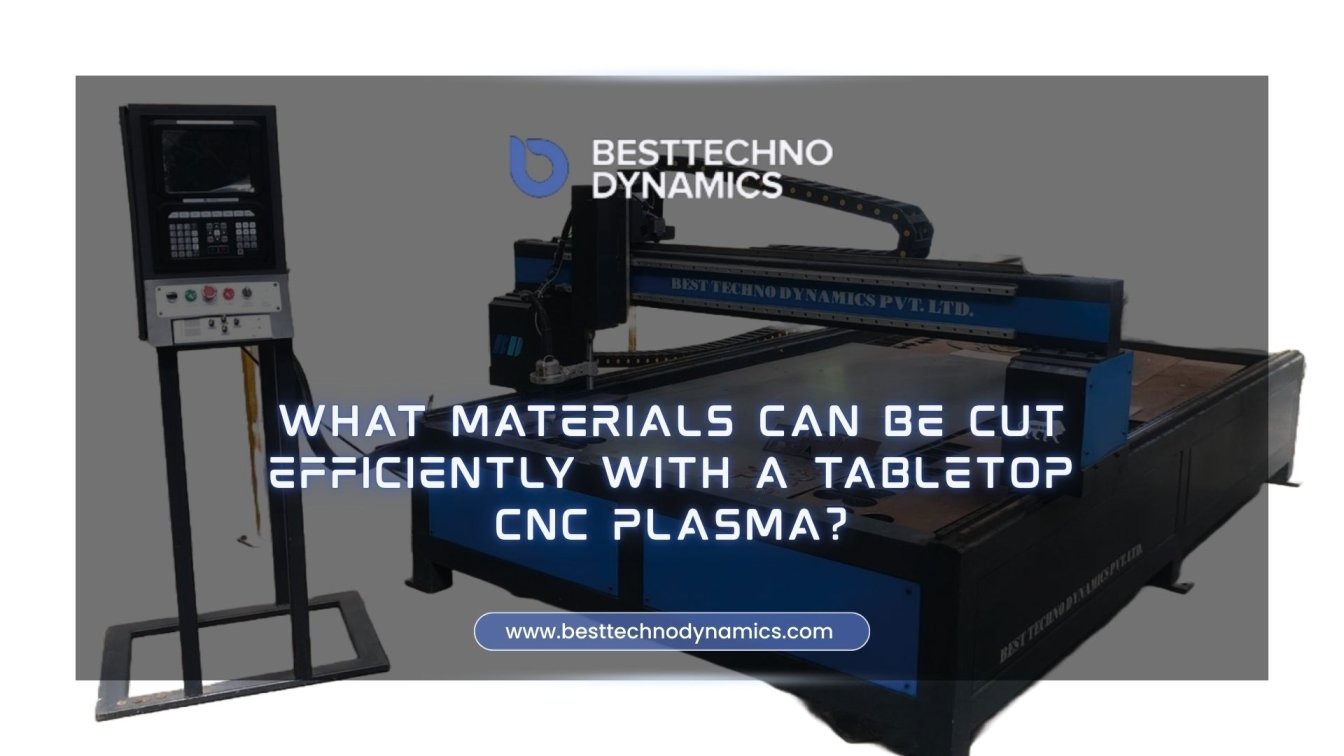
What Materials Can Be Cut Efficiently With a Tabletop CNC Plasma?
Table of Contents
Key takeaways Understanding a tabletop CNC plasma Mild steel Stainless steel Aluminum Galvanized steel Copper and brass Thin vs thick metals Materials that are not suitable Conclusion Frequently Asked QuestionsKey takeaways
- Tabletop plasma cutters efficiently cut conductive metals such as steel and aluminum.
- Ensuring the correct material thickness is essential for optimal cutting performance.
- Proper material selection improves cut quality, reduces material loss, and extends machine life.
The question that comes to mind when investing in a tabletop CNC plasma is what materials it is able to cut effectively. This is important as machine value is based on the accuracy and material range. Tabletop CNC plasma is also popular because it is small, fast, and simple to use. Besides, it is used in workshops and small industries to cut metals cleanly at an affordable price. A CNC machine manufacturer in Gujarat is used by many professionals, but it is important to know the right materials that will give the best results and a long life for the machine.
In this blog, we will tell you about what materials can be cut effectively by a tabletop CNC plasma.
Understanding a tabletop CNC plasma
A tabletop CNC plasma is a machine that cuts electrically conductive metals with the help of a high-temperature plasma arc. Hence, it is most effective with metals that are conductive to electricity. Tabletop models are thinner sheets and medium-duty designed compared to large industrial systems. Nevertheless, they remain very accurate, have smooth edges, and are fast cutters.
Moreover, a significant number of manufacturers of CNC cutting machines in India have created such machines to be flexible; therefore, users can cut various metals without complicated settings.
Mild steel: the most common choice
The most common material that is cut on a table top CNC plasma is mild steel. It is cheap, readily available, and reacts highly to plasma cutting. Mild steel can be cut in the machine without much slag, and mostly the machine cuts it smoothly when the thickness lies within the recommended range.
The most important reasons why mild steel is the best:
- Cuts easily with a stabilized plasma arc.
- Less finishing work on the clean edges.
- Applicable to frames, brackets, and plates.
- In thin and medium-thickness sheets.
Additionally, mild steel cutting does not impose additional pressure on the machine, and this makes it ideal to use in everyday life.
Stainless steel: clean and strong cuts
Another material that can be cut effectively using a tabletop CNC plasma is stainless steel. Plasma cutting is more difficult than mild steel, but it still provides good results when the settings are appropriate. Therefore, it is commonly applicable in kitchen appliances, railings, and decorative panels.
Advantages of cutting stainless steel:
- Smooth and accurate cuts
- Mechanical pressure is unnecessary.
- Perfect in personal shapes and designs.
But stainless steel generates more heat when cutting. Therefore, good speed and torch height are required to achieve optimal results.
Aluminum: light but tricky
Aluminum is lightweight, and it is also utilized in numerous industries. A tabletop CNC plasma has the ability to cut aluminum efficiently; it must be controlled. Aluminum is a good conductor of heat, and therefore the cutting process should be well balanced.
Notable aspects to keep in mind:
- Performs optimally on aluminum sheets of thin material.
- Needs increased cutting speed.
- Adequate airflow enhances the quality of edges.
However, aluminum is not as hard as steel; it requires experience not to have rough edges. Nevertheless, with the correct settings, most CNC plasma cutting machine manufacturers in India will design machines that cut aluminum sufficiently.
Galvanized steel: useful with care
A tabletop CNC plasma can also be used to cut galvanized steel. This is a material that is zinc-coated to prevent rust. The coating and the base metal are easily cut by the plasma arc.
Advantages include:
- Good cutting quality
- Should be used on the roof and structural elements.
But there is a significant caution. The galvanized steel is cut, and the fumes are emitted by the zinc coating. Therefore, ventilation is highly essential to save the operator.
Copper and brass: special use materials
Copper and brass are conductive metals, and therefore, in theory, can be cut using a tabletop CNC plasma. But these materials are not normally utilized, as they are easy to reflect heat and they require specific control.
When cutting copper or brass:
- Thin sheets are only advisable.
- Reduction of speed should be done at a slow pace.
- Best on limited or custom work.
Moreover, these metals are typically cut in case there is no other way to cut them.
Thin metals vs thick metals
A tabletop CNC plasma is applicable with thin- to medium-thickness metals. Thin sheets are sliced more quickly and easily. Conversely, denser metals might need low speed and repeated passes.
General range of thickness that is effective:
- Decorative and detailed work sheets are thin.
- Industrial part of medium thickness.
- Not good with heavy plates that are very thick.
Moreover, the knowledge of material thickness is as important as the selection of the material.
Materials that are not suitable
It is also necessary to understand what cannot be cut by a tabletop CNC plasma. Plasma cutting requires the use of electrical conductivity, and therefore non-metal materials cannot be used.
Materials that cannot be cut:
- Wood
- Plastic
- Glass
- Rubber
- Stone
Therefore, very thick metals are not likely to give clean results and can shorten machine life.
Conclusion
A tabletop CNC plasma provides optimal performance provided it is used with the correct materials. It slices metals such as mild steel, stainless steel, aluminum, and galvanized steel that are conductive. Copper and brass can also be cut to suit a particular need with proper care. The selection of the proper thickness, proper settings, and safe working conditions enhances the quality of output.
However, CNC cutting machine manufacturers in India have gained the trust of many workshops due to the fact that their machines are able to fit the real working requirements and make the cutting process smooth with less wastage.
Frequently Asked Questions
1. What materials can a tabletop CNC plasma cut best?
It can cut mild steel, stainless steel, aluminum, and galvanized steel with correct machine settings.
2. Can a tabletop CNC plasma cut thick metal sheets?
It can cut well on thin to medium metals; exceedingly thick sheets can lower the quality of the cuts.
3. Is a tabletop CNC plasma suitable for non-metal materials?
No, it does not cut wood, plastic, glass, or rubber; it only cuts electrically conductive metals.