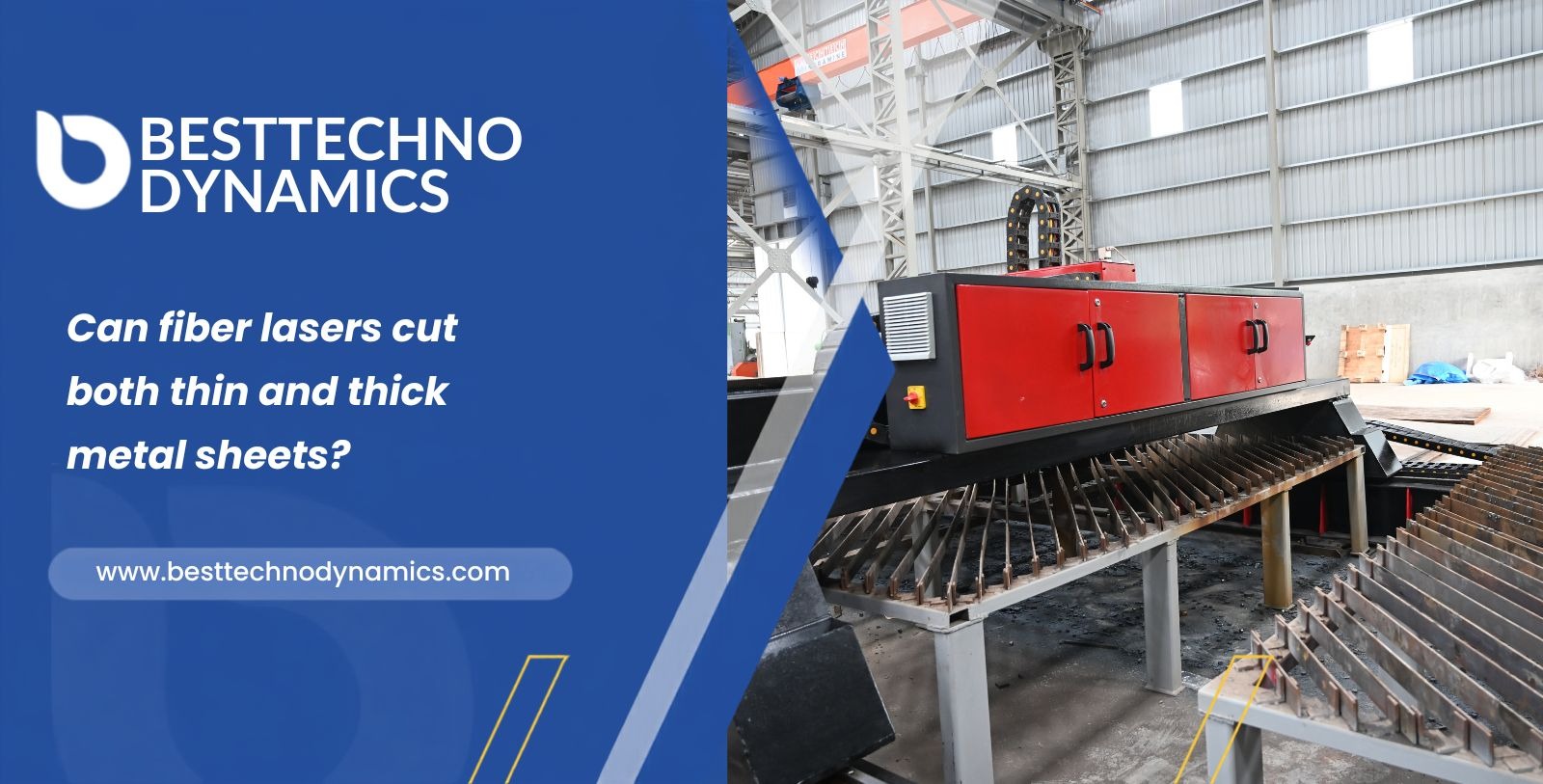
Can fiber lasers cut both thin and thick metal sheets?
As per the topic, the answer is yes, a fiber laser is capable of cutting both, but efficiency is determined by power output.
- Thin sheet metal (6 mm or less): a fiber cutter has exceptional speeds since it is two to five times quicker than a CO2 laser.
- Medium sheets (6 to 20 mm): a 6 kW fiber laser would be the ideal choice.
- Thick sheets (20 mm or more): a 12 kW fiber laser makes the processing faster and has additional capacity.
Gas selection, bed size, and your daily work orders are almost as important as kilowatts. Choose a machine for the types of jobs done in production on a daily basis and regard the catalogue maximum as a limit you will rarely reach.
Key takeaways
- Thin to thick sheets are cut by fiber laser machines; their thickness increases as more power is applied.
- The quoted maximum thickness tends to be greater than that of a cut made neatly during the manufacturing process.
- Both 6 kW and 12 kW are possible depending upon your plate mix.
- The bed size, gas supply, and service are just like a laser for producing more output.
How does a fiber laser actually cut metal?
A fiber laser generates light inside doped optical fibers and sends it to the cutting head through a flexible cable. The beam is focused to a spot a fraction of a millimetre wide. That spot melts or burns the metal, and a jet of assist gas blows the molten material out of the cut.
The wavelength is about one micron, roughly a tenth of a CO2 laser's. Metals absorb the shorter wavelength much better, so more energy ends up in the cut. That is also why fiber copes with reflective metals like brass and copper, which gave older systems trouble.
Machine builders also say a fiber source needs no laser gas, no mirrors to align, and no moving parts in the resonator. Maintenance is lighter, and the beam stays steadier across long shifts.
Why do thin sheets cut so fast on fiber?
Speed that CO2 struggles to match
On thin sheets, supplier data puts a multi-kilowatt fiber laser at two to five times the speed of a CO2 machine. The focused spot is small, and the energy density high, so the beam passes through thin material before heat can spread. The result is a narrow kerf, a small heat-affected zone and less cleanup.
A smaller electricity bill
The efficiency gap is large. Fiber sources convert around 30% of electrical input into laser light, while CO2 systems manage roughly 6 to 15%, depending on the source and the machine.
A shop running two shifts sees that difference on every power bill, and the chiller has less heat to remove.
How thick can a fiber laser really cut?
Thickness capacity climbs with power. Figures differ between manufacturers, gas types, and material grades, so use this table as a planning range.
| Laser power | Mild steel (quoted maximum) | Stainless steel | Aluminium |
|---|---|---|---|
| 3 kW | About 18 to 22 mm | About 8 to 12 mm | About 10 to 12 mm |
| 6 kW | About 20 to 25 mm | About 12 to 20 mm | Up to about 16 mm |
| 12 kW | About 25 to 40 mm | About 20 to 35 mm | Up to about 30 mm |
Maximum thickness versus clean production thickness
A quoted maximum is the thickest plate a machine can separate, often at lower speed and with a rougher edge. Clean, repeatable production usually happens below that figure.
Many suppliers use a rule of thumb. A 6 kW machine suits shops whose regular work is thin sheet with the occasional 8 to 10 mm part, and 12 kW starts to make sense once 10 to 16 mm plate becomes routine.
Where fiber loses its advantage?
A peer-reviewed study of industrial cutting machines found that fiber lasers beat CO2 on efficiency at thin sections. It also found that fiber's efficiency falls faster than CO2's as thickness increases.
Fiber clearly wins on thin and medium sheets. On a very heavy plate its case rests on high power, speed, and running cost, so compare cost per metre before deciding.
6 kW or 12 kW: which one fits your shop?
Neither is automatically better. Both are practical go-to options, and the right pick depends on your plate mix and monthly volume.
When 6 kW makes sense
- Most work falls between 1 and 12 mm.
- The shop handles mixed job work for many customers.
- Purchase price and running cost matter most.
- Plates above 16 mm show up only now and then.
When 12 kW pays off
- Plates of 10 to 25 mm are cut every day.
- Volumes are high, and cost per metre is watched closely.
- The work is structural, heavy engineering, or large-format.
Moreover, one manufacturer reports that its 12 kW machine cuts 1-inch mild steel up to three times faster than its 4 kW model. That speed on thick material is where most of the extra investment pays back.
Three illustrative scenarios
These are examples, not client case studies.
- An enclosure maker cutting 1.5 to 3 mm stainless and mild steel would gain little by going past 6 kW.
- A mixed job shop with 12 mm brackets and thin panels would likely do well on 6 kW.
- A structural fabricator cutting 16 to 20 mm plates daily would recover more from 12 kW through faster cycle times.
Does the assist gas change what you can cut?
The gas shapes edge quality, speed, and cost per part.
- Oxygen suits mild steel, especially thicker plate, and leaves an oxidised edge.
- Nitrogen gives bright, clean edges on stainless steel and aluminium but costs more to run.
- Compressed air is the economical choice for thin to medium mild steel, aluminium and galvanised sheet.
Therefore, one maker advises against air cutting carbon steel beyond 6 mm on a 6 kW machine. Nozzle choice and focus position matter too, and most modern CNC controllers let operators save tested parameter sets for each material and thickness.
Why is fiber laser demand climbing in India?
Laser technology held about 38.4% of India's cutting machine and equipment market in 2025, according to a market study. The same study expects it to be the fastest-growing technology, at roughly 10.4% a year through 2031. A separate analysis puts fiber platforms at about 41% of India's laser revenue in 2025.
Construction adds demand. Brokerage estimates suggest India's pre-engineered building industry grew at around 8% a year recently and could grow 9.5 to 10.5% a year through FY2030. More PEB output means more plates and sections to cut.
Gujarat has a long history here. Ahmedabad was home to some of the earliest Indian builders of fiber laser cutting systems, which is one reason laser machine manufacturers in Gujarat show up on so many buyers' shortlists.
What makes MAMMOTH built for large-format cutting?
MAMMOTH is a heavy-duty CNC fiber laser cutting machine from Besttechno Dynamics. It pairs a 12 kW fiber laser source with a 3100 mm × 12500 mm cutting bed, built for large-format work.
The large bed lets you cut long plates in a single setup, which reduces loading and unloading time and improves material utilisation.
However, typical parts include primary structural frames, secondary members, base plates, gusset plates, connection plates, brackets, and reinforcement components. The machine serves pre-engineered buildings, structural steel fabrication, automotive and auto components, heavy engineering, and general industrial fabrication.
Besttechno Dynamics lists high cutting speed, accurate and repeatable cuts across batches, smooth edges with minimal dross, and less post-processing among the benefits. It also cites lower manpower needs, less material waste, and lower power use than conventional cutting methods.
The 12 kW source also suits automotive and heavy engineering shops, for the same reasons. For shops whose work is mostly thin to medium sheet, 6 kW remains an equally sensible choice.
How do you choose a manufacturer you can rely on?
A dependable CNC fiber laser machine manufacturer India fabricators trust will do more than quote a price. Look for evidence in these areas:
- Sample cuts on your own material and thickness
- Warranty terms on the laser source and the machine
- Spare parts availability and service response time
- Operator and programmer training
- Nesting software support
- Clear site requirements for power, chiller, and floor foundation
Additionally, location counts too. A CNC machine manufacturer in Gujarat can often reach a plant in the state faster for installation and repairs than a supplier several states away, and quicker service means less downtime.
Which buying mistakes cost fabricators the most?
- Buying on maximum thickness, when a catalogue figure rarely matches what cuts cleanly in production.
- Ignoring bed size, then cutting long parts in pieces and wasting time and material.
- Forgetting running costs: gas, electricity and consumables add up over years.
- Skipping sample cuts, although a demo on your own parts shows edge quality and speed in minutes.
- Comparing only price. Among laser machine manufacturers in Gujarat or anywhere else, a low sticker price can hide a thin warranty, slow service, and no training.
- Overlooking future work: if your plate mix is shifting thicker, size the machine for next year's jobs.
What should you do before signing the order?
- List your real jobs and note what share of cutting falls in each thickness band.
- Ask for sample cuts using the parts you actually produce.
- Work out cost per metre, including gas and power, for each power option.
- Check floor space, power supply and material handling.
- Plan operator training before the machine arrives.
Conclusion
Fiber lasers can cut thin and thick sheets. Power, gas, bed size, and support decide how well. A 6 kW machine covers a wide range of shop work, and a 12 kW machine earns its place once thicker plate is the daily routine.
Start from your real jobs, test the machine on your own parts, and weigh service as heavily as the spec sheet. That works whether you choose a CNC machine manufacturer in Gujarat or one further away.
Want to see how MAMMOTH or a 6 kW option handles your material? Send your sheet and plate thicknesses to Besttechno Dynamics and ask for a sample cut. If you are comparing a CNC fiber laser machine manufacturer India-wide, a test on your own parts is the quickest way to decide.
Frequently asked questions
1. Can a fiber laser cut both thin and thick metal sheets?
Yes. Fiber lasers cut thin sheets and heavy plates, but the thickness range depends on laser power, assist gas, and the material being cut.
2. How thick can a 6 kW fiber laser cut?
At maximum, roughly 20 to 25 mm of mild steel. Clean production cutting is usually done at lower thicknesses.
3. How thick can a 12 kW fiber laser cut?
Manufacturers quote up to about 40 mm of mild steel and 20 to 35 mm of stainless steel at maximum capacity.
4. Is 12 kW always better than 6 kW?
No. 12 kW pays off when a 10 to 25 mm plate is cut regularly. For mostly thin to medium sheets, 6 kW is often the smarter investment.
5. Which metals can a fiber laser cut?
Mild steel, stainless steel, aluminium, brass, copper and galvanised sheet. Fiber handles reflective metals far better than CO2 did.
6. Is a fiber laser better than a CO2 laser for metal?
For most metal cutting, yes. Fiber is faster on thin sheets, converts about 30% of electrical input into light, and needs less maintenance.
7. Does the assist gas really matter?
Yes. Oxygen suits thicker mild steel, nitrogen gives clean edges on stainless and aluminium, and compressed air lowers cost on thinner work.
8. What is the cutting area of the MAMMOTH machine?
MAMMOTH has a 3100 mm × 12500 mm cutting bed and a 12 kW fiber laser source, built for long plates and large-format work.
9. How do I shortlist a supplier?
Ask for sample cuts, compare warranty and service terms, and check spare parts access. A CNC machine manufacturer in Gujarat may also offer quicker on-site support if your plant is nearby.
10. Where can I find fiber laser builders in Gujarat?
Ahmedabad has been a hub for Indian fiber laser machine building for years. Compare laser machine manufacturers in Gujarat on service, training, and sample-cut quality as well as price.