05 Aug, 2026
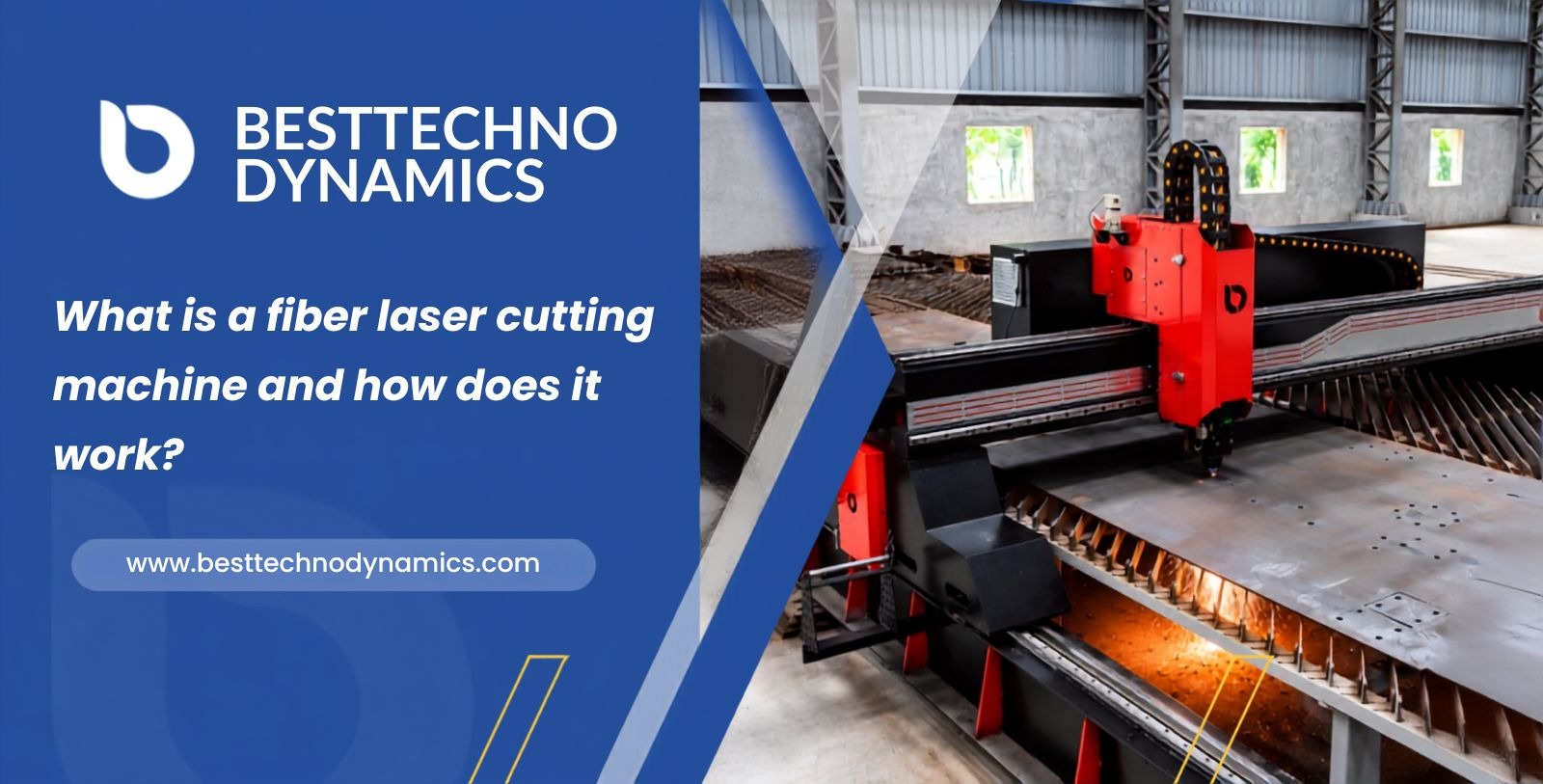
What is a fiber laser cutting machine and how does it work?
Key Takeaways
- The fiber laser cutting machines are capable of making correct and accurate cuts while minimizing heat distortions.
- With increased laser power, higher thickness can be cut at faster speeds and using less energy.
- The machines with larger bed sizes can carry out long structural steel and prefabricated steel buildings.
- It is important to find a reliable manufacturer of CNC fiber laser machines in India.
Cut open the process, and a fiber laser cutting machine does something fairly simple: it fires a high-intensity beam, generated inside optical fibers, through a focusing lens onto the metal. The beam melts or vaporizes the surface along a set path, and a jet of assist gas clears the molten metal away to leave a clean edge. That's the whole trick. It's replaced plasma and CO2 cutting in most fabrication shops because it's faster, more accurate, and wastes less material.
If you run a fabrication unit, a PEB manufacturing setup, or an automotive parts business, you've probably had this technology come up in nearly every conversation about upgrading your cutting line. Knowing how it actually works and what separates a good machine from a mediocre one matters a lot more once you're the person signing the purchase order.
This guide walks through the mechanics, the practical upside, and what to check for when choosing a CNC fiber laser machine manufacturer in India.
What is a fiber laser cutting machine?
It's a CNC-controlled machine that uses a solid-state laser source, built from optical fibers doped with rare-earth elements, to cut through metal sheets and plates. CO2 lasers rely on gas-filled tubes; fiber lasers generate their beam through a diode-pumped fiber medium instead, which is why they run more efficiently and need less upkeep.
Four parts do most of the work:
- Laser source – generates the cutting beam
- CNC control system – guides the cutting head along the programmed path
- Cutting head with focusing lens – concentrates the beam onto the material
- Cutting bed – holds the material in place during processing
However, you'll find these machines across metal fabrication, automotive manufacturing, sheet metal processing, and heavy industrial work.
Fiber Laser vs CO2 Laser: what's the difference?
CO2 lasers ran the show for years. Fiber has mostly taken over for metal cutting because it handles reflective metals like aluminum, brass, and copper more reliably, uses less electricity, and skips the mirrors and gas mixtures CO2 machines need constant fussing with. CO2 still holds some ground outside metal cutting, but for steel fabrication, fiber is the practical pick now.
How does fiber laser cutting actually work?
Divide it into steps, and everything will make sense.
- Beam generation: Light is pumped into an optical fibre containing a dopant such as ytterbium to increase the light to a high-intensity beam.
- Beam delivery: This beam is delivered through the fibre cable almost without losing any energy.
- Focusing: A lens in the cutting head focuses it down to a very small, high-energy point, usually less than a millimeter wide.
- Cutting: There, the beam will heat the metal until it is molten or vaporized. Meanwhile, assist gas, typically oxygen, nitrogen, or compressed air, is blown through the same nozzle to push the molten metal out of the way.
- CNC-guided movement: The path is programmed by CNC software; the cutting head moves according to the shape loaded from a design file.
Furthermore, it is the combination of concentrated heat and precise movement that makes fiber lasers able to cut intricate shapes into thick steel without rough edges or warping the plate.
Why does assisted gas matter more than people think?
Most buyers don't realize how much the type of gas they select will affect the outcome. Oxygen increases cutting speed in carbon steel, as an exothermic process, but can cause an oxidized edge to remain. Nitrogen provides a cleaner cut without any oxide; it is important with stainless steel or when welded subsequently. If you do get it wrong, your fabrication team will be doing that extra grinding when they don't need to be!
Why are manufacturers switching to fiber lasers?
Switching from plasma to CO2 or fiber typically is noticed by the shops after a couple of production runs, not months.
- Faster cutting speeds: Fiber has a much faster cutting speed than CO2 on thin to medium thickness metal, reducing project time.
- Improved edge quality: There will be less dross, and less grinding required before the next step in the production process.
- Reduced running costs: Due to no gas resonator, no mirror alignment, and reduced overall electrical consumption.
- Better accuracy for complex forms: A narrow beam equates to tighter tolerances, a factor that is important for components that must be fitted together on assembly.
- Extended machine life: Solid-state sources can last for tens of thousands of hours before their performance begins to degrade.
For PEB manufacturing and structural steel fabrication, where thick plates and long components are just the daily reality, these gains show up directly in faster turnaround and lower cost per part.
Introducing MAMMOTH: built for PEB and heavy fabrication
Standard-size machines become a bottleneck fast once you're working with thick plates, long structural members, or high volumes of PEB components. Besttechno Dynamics built MAMMOTH, a heavy-duty CNC fiber laser cutting machine, specifically for that gap.
MAMMOTH runs an oversized cutting bed of 3100 mm × 12500 mm, and it comes in 6 kW or 12 kW. It's a mistake to assume every PEB company needs the top power option. Both configurations earn their place: 6 kW suits shops cutting thinner to medium-gauge steel at high volume, while 12 kW is built for facilities that are regularly slicing through thick plate and need the cutting speed that comes with it.
What makes MAMMOTH suitable for PEB work?
PEB work means long structural frames, base plates, gusset plates, and connection brackets, usually in large batches with tolerances that don't leave much room for error. MAMMOTH's oversized bed lets a full-length steel plate go through in one setup, which cuts down on loading time and the handling mistakes that creep in when you're repositioning material constantly.
It handles:
- Primary and secondary structural frames
- Base plates and gusset plates
- Connection plates and reinforcement brackets
- Heavy structural steel components for industrial buildings
Industries that benefit from MAMMOTH
Structural steel fabrication, automotive component production, heavy engineering, and general industrial fabrication units working with large-format sheets all use it, beyond just PEB manufacturing.
Practical Benefits Reported by Fabrication Units
- Higher throughput from faster cutting on both thin and thick material
- Consistent accuracy across large batches
- Lower operating costs from reduced manpower and less wasted material
- Lower energy use than older cutting technologies
- Solid long-term ROI, since reliability and low maintenance add up over time
Choosing the right CNC fiber laser machine manufacturer
A fiber laser machine is a long-term purchase, so the manufacturer behind it counts for as much as the specific sheet.
What to Look for in a Manufacturer
- Local manufacturing and support: A CNC fiber laser machine manufacturer in India with local production gets you spare parts and technicians faster than an overseas supplier ever could.
- Machine customization options: No two fabrication units run the same setup. A manufacturer offering configurable bed sizes and power options fits you better long-term than one selling a single fixed design.
- Proven track record with heavy industries: If you're in PEB manufacturing or structural steel fabrication, buying from a PEB laser cutting machine supplier India- based operators already cuts down the risk of ending up with equipment that's wrong for your load.
- After-sales service and training: Downtime costs money. Look for a manufacturer who trains your operators and answers the phone when something breaks, not one who disappears after delivery.
Why has Gujarat become a manufacturing hub for CNC machines?
Gujarat's industrial base, port access, and logistics network make it a natural fit for heavy machinery production. A CNC machine manufacturer in Gujarat generally means shorter delivery times and easier servicing than sourcing from further afield, which is part of why fabrication units across the country keep gravitating toward a CNC machine manufacturer in Gujarat for their fiber laser purchases.
Common mistakes buyers make
- Opting for the least expensive, least powerful machine: This seems like a good idea on the surface, but can slow production if you use thicker material than the machine is comfortable working with.
- Failure to consider bed size requirements: When purchasing a laser cutter, users get caught up in the power of the laser and neglect to consider the size of the bed of the laser cutter.
- Not visiting factories or demos: A specific sheet is of little benefit if you've never seen the actual machine cutting your actual material.
- Failure to estimate the needs of after-sales service: The machine can not be as reliable as the service. Time out with prompt support comes at a cost greater than the equipment itself.
- Overlooking operator training: Even a great machine underperforms in untrained hands. The quality of the cut and life span of the machine is influenced by training.
Expert recommendations before you invest
Request a demonstration of the cutting process before signing anything with the live materials available at your thickness. Try to pressure the manufacturer with delivery dates, warranties, and the speed at which parts and techs can get to your facility. When considering cutting large structural pieces on a regular basis, consider both the size and power of the machine, not as two individual checks. And speak to your current customers within your respective industry. For more than any brochure can tell you, feedback from someone who has an equivalent production load will tell you.
Wrapping up
With higher cutting speed, better edge quality, and lower operating expenses than traditional cutting technology, fiber laser cutting has transformed the way metal is fabricated. Whether it is the manufacturing of PEB or structural steel fabrication, choosing the right machine and the right CNC fiber laser machine manufacturer India will automatically translate to changing the efficiency of your production process and your costs in the long run. MAMMOTH was designed with this type of heavy-cutting job in mind, and has a large format bed and a power that can be configured.
When you're considering a fiber laser machine, consider the power and bed size based on what you need to cut, NOT what is affordable.
If you are considering investing in a heavy-duty fiber laser cutting machine for your fabrication line, you need to choose the right model. If you are planning to upgrade your fabrication line with a reliable fiber laser cutting machine, you must make sure you select the right model. If you're unsure which one of the MAMOTH configurations is right for your production, contact us to discuss it, or schedule a live cutting demo at our facility.
Frequently asked questions
1. What is a fiber laser cutting machine used for?
Precision cutting of metal plates and sheets, mainly used in structural steel manufacturing, automotive industry, and the production of components for PEB.
2. How thick a material can a fiber laser cutting machine cut?
This is dependent on power. Thinner to medium-sized steels are a good fit for the 6 kW machine, while thick plate is a better fit for the 12 kW machine.
3. Is fiber laser cutting better than plasma cutting?
Yes, for most metal fabrication. More tolerances, cleaner edges, and less heat distortion than plasma can provide.
4. What assist gas is used in fiber laser cutting?
Depending on the metal and the edge finish desired, oxygen, nitrogen, or compressed air are selected.
5. How long does a fiber laser source typically last?
Most of the runs are good for tens of thousands of hours before they begin to lose their performance.
6. What size cutting bed do PEB manufacturers need?
Depending on the length of the component, it can change but for a large format bed such as MAMOTH's 3100 mm X 12500 mm, it can be used in one setup instead of several.
7. Why choose a local CNC fiber laser machine manufacturer in India instead of importing?
Machines that are built to local manufacturing conditions instead of conditions of another country, faster parts, faster technician response.
8. Does fiber laser cutting reduce material waste?
Yes. The narrow beam will nest the parts into the sheet more tightly, reducing scrap compared to previous techniques.
9. What maintenance does a fiber laser cutting machine require?
Much less than a CO2 laser, as there are no mirrors or gas resonators to control. Cleaning and calibration checks of lenses are still important.
10. Is a 12 kW fiber laser machine only useful for PEB companies?
No. It suits PEB and heavy plate work well, but a 6 kW machine handles thinner materials at high volume just as effectively for other production needs.