Which Metals Can a 12kW Fiber Laser Cut? A Materials Guide
The cutting thickness of mild steel is approximately up to 40mm, with stainless steel being cut at around 25 to 30mm. The laser machine can also cut through aluminum, brass, copper, galvanized steel, or other alloys and needs particular assistance gas settings for the operation. The benefit of high wattage is fast cutting of material, not any size advantage on the specification sheet.
- Mild/carbon steel - maximum thickness 40mm with oxygen assistance
- Stainless steel - max thickness of 25 to 30mm with nitrogen assistance
- Aluminum - cuts up to a thickness of 25 to 30mm with stable beam control
- Copper and brass- This can be cut with the right laser power
A 12kW device is best suited for PEB fabrication, structural steel processing, and heavy plate cutting. The 6kW device is preferred for more delicate metal and general job shop usage. Your average plate thickness will determine which one of the devices is the best choice, not the highest figure provided by a CNC fiber laser machine maker from India.
Key takeaways
- A fiber laser rated for 12 kW can be used for the cutting of mild steel, stainless steel, aluminium, copper and brass.
- The higher wattage means faster cutting, particularly for plate thicknesses in excess of 12 mm.
- The industries that stand to gain the most from regular service in the field of heavy-duty cutting include PEB producers and builders alike.
- Do not just go for the highest wattage rating; determine the wattage required to cut the materials you are working with.
How does laser power actually affect cutting capacity?
Simply having the higher wattage does not guarantee that a laser will cut better. There are three important considerations for the capabilities of the laser:
- Beam quality
- Assist gas
- Design of the cutting head.
A higher wattage source provides more energy density to the cutting point, so it can melt and vaporize metal. Two different sources of 3kW and 12kW will produce the same cut quality on thinner materials, but the speed at which they achieve this will be different. But when working with materials thicker than 12 mm or 15 mm, a lower-power source will produce a slower cut and potentially worse edge finish compared to a 12kW welding head.
Assisting gas is also important. Oxygen reacts with metal. Adds extra heat, which can help cut thicker steel at moderate laser power. Additionally, oxygen can leave an edge and create a heat-affected zone.
Nitrogen gives an oxide-free cut, making nitrogen a common choice for stainless steel and aluminum. However, cutting the thickness with nitrogen generally requires more laser power.
India’s laser market is also growing as manufacturers adopt advanced laser systems. Recent market reports show increasing demand for fiber lasers and higher‑power systems for metal processing and heavy fabrication.
Mild steel and carbon steel: the workhorse metal
Mild steel is where 12kW lasers show what they can do. With oxygen assist, a 12kW machine cuts mild steel up to around 40mm, and some manufacturers rate their systems even higher under ideal conditions. Switch to nitrogen for a cleaner, oxide-free finish, and thickness capacity drops to closer to 15 to 20mm, since you're trading maximum thickness for edge quality.
A few practical notes for mild steel cutting:
- Thinner sheets, under 6mm, cut extremely fast on a 12kW machine, sometimes faster than the material handling system can keep up with.
- Above 20mm, cutting speed drops sharply even on high-power machines, so realistic throughput matters more than the number on the spec sheet.
- Oxide buildup on the cut edge from oxygen assist may need light grinding before painting or welding, depending on your finishing standards.
- It's the metal that PEB and structural steel fabricators cut most, and that's why 12kW machines are so common in that segment.
Stainless steel: where nitrogen does the heavy lifting
Stainless steel behaves differently from mild steel because it needs nitrogen assist to avoid discoloration and oxidation at the cut edge. A 12kW fiber laser typically handles stainless steel up to 25 to 30mm with nitrogen, though nitrogen consumption at that thickness gets expensive fast. Gas pressure and flow requirements climb along with the plate.
Some fabricators switch to oxygen for very thick stainless plates just to save on gas, accepting the darker, oxidized edge as a trade-off. Whether that's acceptable depends on the end use. Structural brackets can tolerate it. Food-grade or visible architectural components usually can't.
Furthermore, stainless steel also conducts heat differently than mild steel, so cutting speed and focus settings need separate tuning. A machine dialed in perfectly for mild steel won't hand you clean stainless cuts without adjustment.
Aluminum: reflective, fast, and slightly tricky
Aluminum is highly reflective, which historically made it hard to cut with lower-power CO2 lasers. Fiber lasers do a much better job because of their shorter wavelength, and a 12kW source can process aluminum up to roughly 25 to 30mm with nitrogen assist.
The tricky part with aluminum isn't the thickness. It's consistent. Alloys vary in reflectivity and thermal conductivity by grade, so a 5mm aluminum sheet from one alloy batch can cut differently than the next. A well-calibrated machine with stable beam control, something worth asking about when comparing machines from any fiber laser cutting machine manufacturers in India, cuts down on that variation considerably.
Therefore, automotive component makers and general fabrication shops rely on aluminum cutting the most, and both need repeatable results across long production runs, not a single good test cut that never gets matched again.
Copper, brass, and other reflective metals
Copper and brass give any fiber laser trouble, 12kW machines included, because their reflectivity can bounce laser energy back toward the cutting head if the machine isn't built for it. Modern 12kW systems with proper beam protection cut copper and brass reliably in the 3 to 12mm range, though thicker sections need slower speeds and careful gas pressure management.
Galvanized steel is more straightforward. The zinc coating burns off during cutting, and a 12kW machine handles galvanized sheet much like mild steel, just with a bit more fume extraction needed. Manganese steel and other structural alloys used in heavy engineering also sit comfortably within a 12kW machine's range, generally up to 20 to 25mm depending on the alloy.
Why PEB and structural steel fabricators lean toward 12kW?
Pre-Engineered Building manufacturing runs on thick structural components: primary frames, base plates, gusset plates, connection brackets, most of it in the 10 to 30mm range. That's exactly the thickness band where lower-power lasers slow to a crawl and 12kW machines keep cutting at a workable pace.
India's structural steel cutting segment is expected to grow faster than sheet metal cutting overall, at close to 9% CAGR through 2031, driven by infrastructure and industrial project activity. That's a big part of why more PEB units are moving away from plasma cutting toward fiber lasers for their plate processing.
Moreover, the advantage isn't only about thickness. A 12kW machine on a large-format bed cuts long structural members in a single setup, which cuts down on repositioning time and material handling labor across a production run.
MAMMOTH: A 12kW machine built for large-format cutting
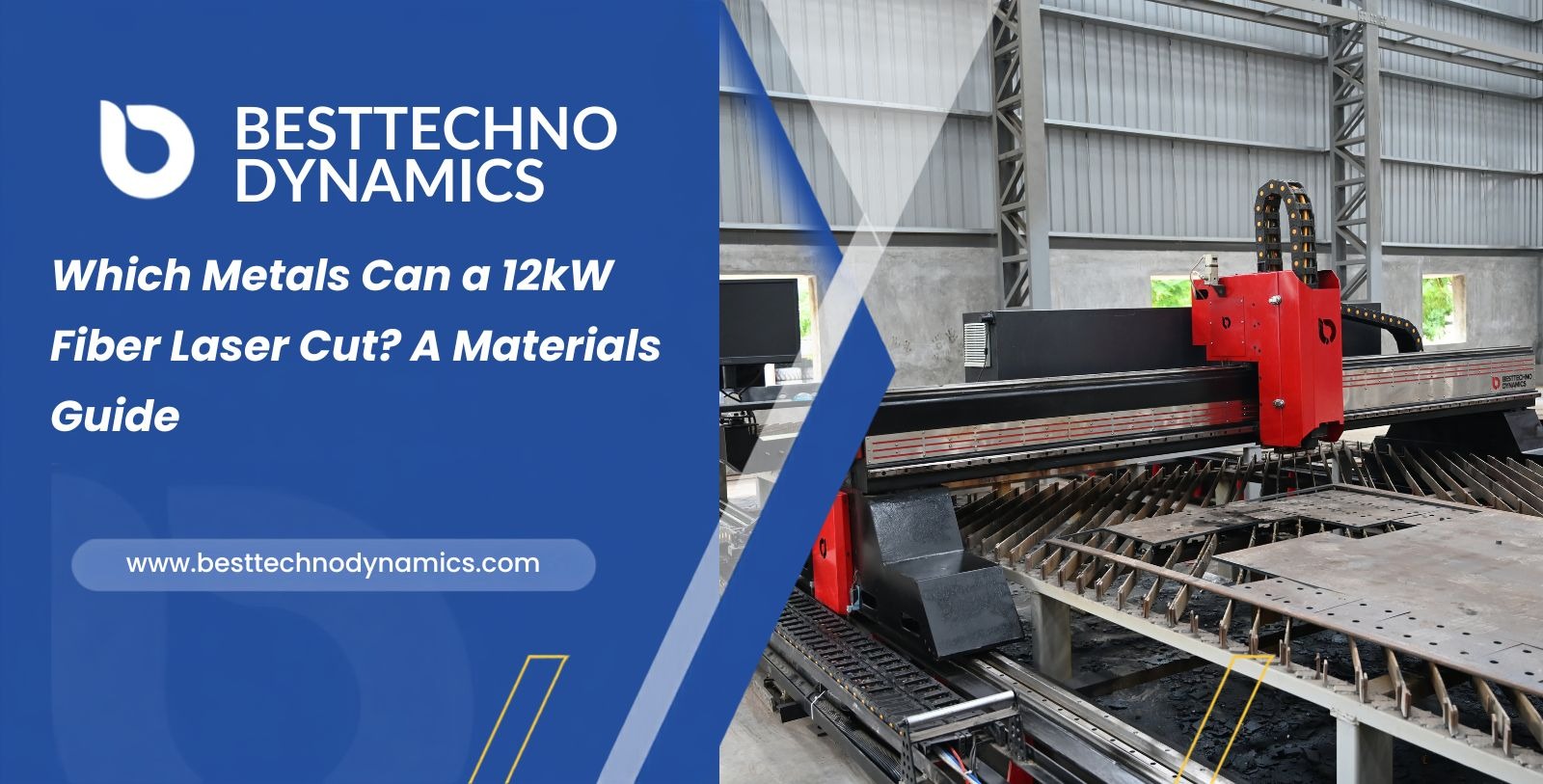
Besttechno Dynamics builds the MAMMOTH CNC fiber laser cutting machine around exactly this kind of heavy-duty work. It runs a 12kW fiber laser source on a cutting bed of 3100mm by 12500mm, large enough to process long structural members, base plates, and gusset plates in one pass instead of repositioning the sheet halfway through a job.
The oversized bed matters more than it sounds like it would. On smaller tables, a fabricator cutting long steel beams has to reload and realign the material partway through, which adds time and opens the door to alignment error. MAMMOTH's working area removes that step for most structural components, and that's a big reason PEB fabricators, structural steel units, automotive component makers, and heavy engineering shops have adopted it.
Where it fits in day-to-day production:
- Primary and secondary structural frames for PEB projects
- Base plates, gusset plates, and connection brackets
- Long structural steel components that don't fit standard-size cutting beds
- High-volume automotive and industrial machinery parts
A 12kW machine like MAMMOTH isn't only for PEB companies, and it shouldn't be pitched that way. Any fabricator working with mid-to-thick plates, in automotive, general engineering, or industrial equipment manufacturing, gets the same benefit from the combination of speed and thickness range. A 6kW machine is still a solid, cost-effective option for shops mostly cutting thinner sheets. Besttechno Dynamics makes both, because neither wattage is the right answer for every buyer.
Should you buy 6kW or 12kW? A realistic comparison
This is the question most buyers actually need answered, and the honest answer is that it depends on what you cut most often, not what sounds more impressive in a meeting.
| Factor | 6kW Machine | 12kW Machine |
|---|---|---|
| Best for | Sheet metal, thinner plate (up to ~15mm) | Thick plate, structural steel (15 to 40mm) |
| Cutting speed on thin sheet | Fast, efficient | Fast, but power is underused |
| Cutting speed on thick plate | Slow, may struggle above 20mm | Significantly faster, better edge quality |
| Running cost | Lower power consumption | Higher power draw, higher gas consumption on thick cuts |
| Typical buyer | Job shops, general fabrication | PEB units, structural steel, heavy engineering |
| Upfront investment | Lower | Higher |
If your daily production mix is mostly under 12mm plate, a 6kW machine gets the job done at a lower operating cost, and paying for 12kW capacity you rarely touch doesn't make financial sense. If you're regularly cutting 15mm and up, or you can see your business moving toward heavier fabrication work, the 12kW investment tends to pay for itself through faster turnaround and less reliance on secondary cutting methods like plasma or oxy-fuel.
Choosing a CNC laser machine dealer
Gujarat has become one of India's stronger manufacturing hubs for structural steel, PEB components, and industrial machinery, and that's precisely why the region now has several CNC laser machine dealers in Gujarat competing for the same customers. Not every dealer with a similar-looking spec sheet offers the same after-sales support, and that gap tends to show up once the machine has been running for a year or two, not on day one.
A few things worth checking before committing to any CNC laser machine dealer in Gujarat or elsewhere in the country:
- Local service response time- a laser machine down for a week costs real production days. Ask how quickly technicians actually reach your facility.
- Spare parts availability in India, not just at the manufacturer's overseas headquarters. Lead times on imported parts can stretch into weeks.
- Operator training, since a 12kW machine's settings for mild steel, stainless, and aluminum aren't interchangeable, and undertrained operators waste material learning by trial and error.
- Reference installations, ideally in your own industry, so you see how the machine performs on your actual material mix rather than a demo piece.
Furthermore, working with an established fiber laser cutting machine manufacturer in India, rather than a pure reseller, usually means faster support and someone accountable if adjustments are needed after installation.
Common mistakes buyers make when comparing wattage
- Assuming maximum thickness equals practical thickness- A specific sheet number is usually tested under ideal conditions. Real production speed at that thickness is often a lot slower.
- Ignoring gas consumption costs- Nitrogen use on a 12kW machine cutting 25mm stainless steel adds up fast, and that ongoing cost rarely gets mentioned in the sales pitch.
- Buying for future needs that never show up- Paying for 12kW capacity while cutting mostly 6mm sheets for the next three years is money that could have gone elsewhere in the business.
- Overlooking bed size- A powerful laser on a small table still means repositioning for long structural components, which undoes some of the speed advantage.
- Skipping operator training in the purchase decision- The best machine in the world underperforms in untrained hands.
Expert recommendations
Match the machine to your actual production data, not your busiest month. Pull job records from the last year and check what share of your work falls above 15mm plate thickness. If it's a small slice, a 6kW or 8kW machine likely serves you better financially, with room to add a second machine later if volume grows.
For fabricators already committed to structural steel, PEB components, or heavy plate work, weigh bed size alongside wattage. A 12kW laser on a table too small for your longest components still means manual repositioning, and that limits the speed gains you're paying for.
Ask any CNC fiber laser machine manufacturer India for a test cut on your actual material, at your actual thickness, before finalizing the purchase. Demo videos rarely reflect real production conditions.
Bottom line
A 12kW fibre laser can cut mild steel to a thickness of approximately 40mm, while the same unit can cut stainless steel and aluminium to about 25-30mm depending on other factors. It is also capable of cutting copper, brass, and galvanized steel, which puts it in demand in PEB, structural steel, and heavy engineering.
When selecting a manufacturer of CNC fibre laser machines in India, one should not restrict their view to only the power of the machine. The bed size, the amount of gas used by the unit, the service provided by the manufacturer, and the materials commonly processed by the user must also be taken into consideration. Besttechno Dynamics produces both 6kW and 12kW machines, including the huge MAMMOTH model for the cutting of PEB and structural steel, which is helpful for manufacturers to select the correct unit for their production.
Frequently asked questions
1. What is the maximum thickness a 12kW fiber laser can cut?
A 12kW fiber laser cuts mild steel up to roughly 40mm with oxygen assist, and stainless steel or aluminum up to about 25 to 30mm with nitrogen assist, depending on the machine's cutting head design.
2. Can a 12kW fiber laser cut aluminum cleanly?
Yes. Fiber lasers handle aluminum's reflectivity far better than older CO2 lasers, and a 12kW source can cut aluminum up to 25 to 30mm with nitrogen assist and stable beam control.
3. Is a 12kW laser only useful for PEB manufacturing?
No. PEB and structural steel fabricators benefit heavily from 12kW machines, but automotive component makers, heavy engineering units, and general fabrication shops working with mid-to-thick plates get real speed advantages too.
4. Should a small fabrication shop buy a 12kW machine?
Only if a meaningful share of daily production involves plates above 15mm. Shops cutting mostly thinner sheet metal typically get better value and lower running costs from a 6kW or 8kW machine.
5. What metals can a fiber laser cut besides steel?
Fiber lasers cut stainless steel, aluminum, copper, brass, galvanized steel, and various structural alloys, though reflective metals like copper and brass need machines built with proper beam protection.
6. Why does stainless steel need nitrogen instead of oxygen?
Nitrogen assist prevents oxidation at the cut edge, keeping stainless steel's clean, corrosion-resistant finish intact, while oxygen assist leaves a darker, oxidized edge.
7. How much does bed size matter compared to laser power?
For long structural components, bed size matters as much as wattage. A powerful laser on a small table still requires repositioning material, which slows production regardless of cutting speed.
8. What should I check before choosing a CNC laser machine dealer in Gujarat?
Confirm local service response times, spare parts availability within India, operator training support, and reference installations in a similar industry before finalizing a purchase.
9. Does higher laser wattage always mean faster cutting?
Only past a certain thickness. On thin sheet metal, a 6kW and 12kW laser cut at similar speeds. The gap widens sharply once plate thickness passes 12 to 15mm.
10. What industries typically buy 12kW fiber laser machines in India?
Pre-Engineered Building manufacturers, structural steel fabricators, automotive component producers, and heavy engineering or industrial machinery units are the most common buyers of 12kW fiber laser cutting machines.