Gantry Fiber Laser vs CO₂ Laser: Which Is Better for Metal Cutting?
Table of Contents
- Key takeaways
- What is a gantry fiber laser cutting machine?
- How does a CO₂ laser cutting machine work?
- Key differences between fiber and CO₂ lasers
- Which is better for metal cutting: fiber or CO₂?
- Fiber vs CO₂ comparison table
- Which industries benefit most?
- How to choose between 6 kW and 12 kW fiber lasers?
- How to choose a CNC fiber laser machine manufacturer?
- Common mistakes to avoid
- Bottom line
- Frequently asked questions
Making the right decision about cutting technologies is one of the most important capital investments a fabrication company has to make. Factory owners as well as procurement team leaders in PEB units of India must compare fiber laser technology with CO₂ lasers before purchasing their machines. Choosing the right technology has an impact on cutting speed, cost of the operations and types of materials that can be cut.
The purpose of this guide is to show how gantry fiber lasers and CO₂ lasers work, where each technology is used in the situation of a particular application and how to select CNC fiber laser manufacturing companies in India with confidence. You will also learn how to choose a 6 kW laser or a 12kW laser based on your needs. The sections of this guide were not written just to describe these technologies, but to help you make a decision regarding the choice of the technology.
Key takeaways
- Fiber lasers often fit the bill for most of the CNC fiber laser machine manufacturing company in India customers that are evaluating metal cutting machines.
- The wavelength is significant: fiber lasers are more trustworthy with copper, brass and aluminium than CO₂ lasers.
- Choose from 6kW or 12kW options to suit your plate thickness, production, bed size and budget requirements.
What is a gantry fiber laser cutting machine?
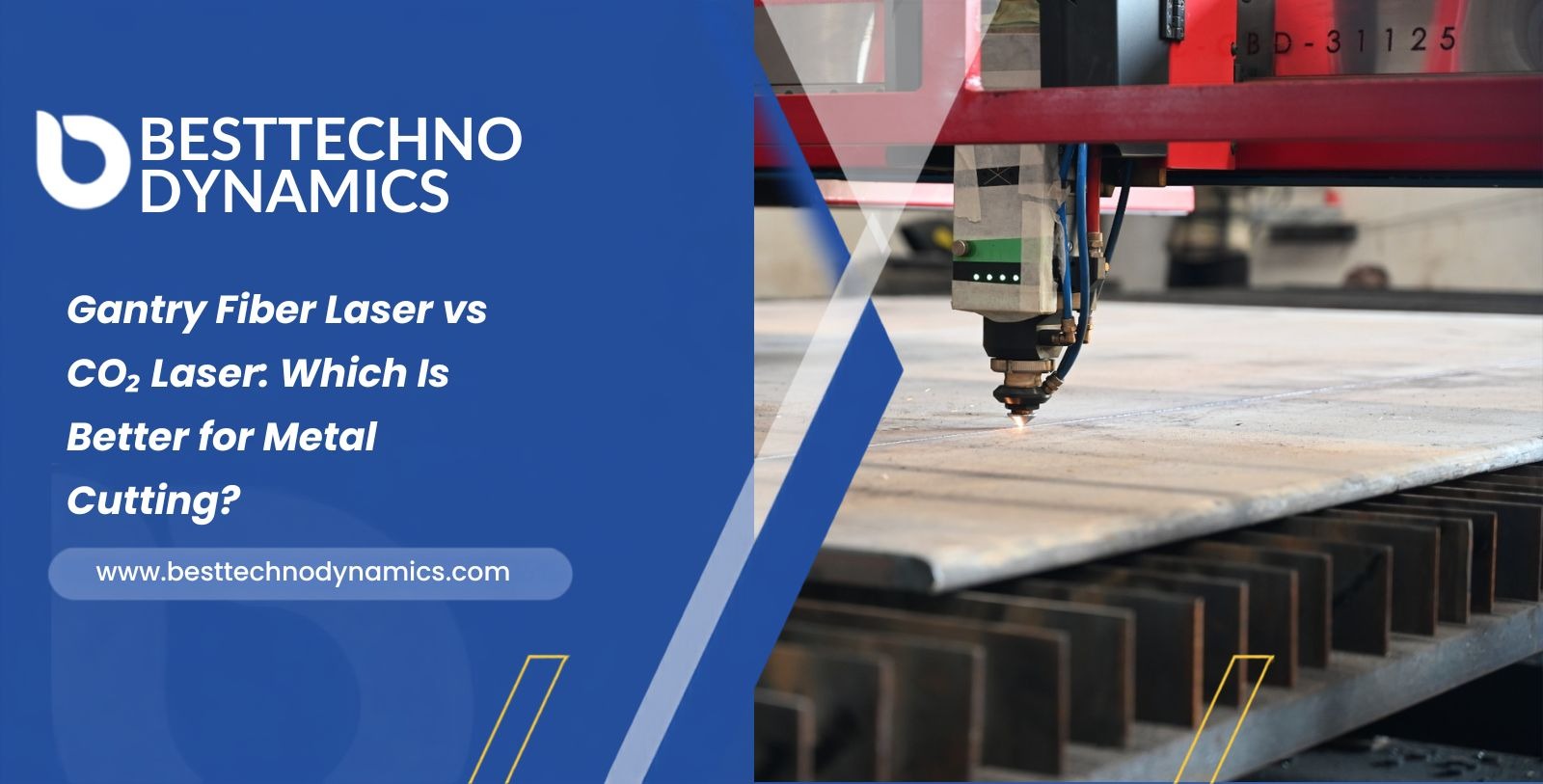
A gantry fiber laser cutter is a computer-controlled device that utilizes a fiber laser to generate laser beams, which are transmitted through a fiber cable to a cutting apparatus. The cutting apparatus moves across the flat surface of the machine, which adds X and Y movement to achieve accurate cuts.
Gantry machines are widely used in heavy-duty manufacturing applications, where they offer a combination of low-cost designs and good cutting precision. Manufacturing suppliers of fiber laser cutters would provide various sizes of gantry lasers, allowing users to select their ideal welding machine according to the dimensions of the sheet metals being cut. Gantry Type Laser Cutting Machine manufacturer in India will be beneficial.
Core components of a Gantry Fiber Laser
Various gantry fiber lasers have a general assembly of items to make them operate effectively. These include:
- Fiber Laser source: The beam generator for the cutter that gets to decide the cutting capacity (6 kW or 12 kW).
- Fiber delivery cable: The cable transmitting the beam from the source directly to the cutting head.
- Cutting head: The device capable of focusing the beam through the lens and supplying the assist gas through the nozzle.
- Gantry and drive system: The system in charge of the correct movement of the cutting head along coordinates X and Y.
- CNC controller: The unit storing information about the pre-determined cutting line and assuring the laser power and movement to comply with it.
Familiarity with all the components will help you to contrast different manufacturers' specs. It will also help make the right inquiries concerning the spare parts and service support.
How does a CO₂ laser cutting machine work?
A CO₂ laser cutting apparatus produces its beam within a closed resonator that is filled with gas, and that gas contains carbon dioxide. The workings of the beam generate near 10.6 micrometers in wavelength. The mirrors make it possible for this beam to reach a focusing lens in the cutting head, through which the beam hits the workpiece.
This technology has existed in industries for a long time and continues being applicable for certain types of metals and non-metals. Meanwhile, the optical pathway of the technology is much more complicated than that of fiber systems and requires keeping mirrors clean and aligned during them.
How mirrors deliver the beam?
In the CO₂ method, there are a few mirrors where the beam passes through before reaching the cut head; with each reflection, there is a risk of losing some power and possibly misaligning the beam, which requires looking after these optics regularly.
This makes the CO₂ systems more complex in terms of optical alignment issues compared to fiber systems that avoid these extra problems by using a flexible fiber.
Key differences between fiber and CO₂ lasers
There are five major differences between the two technologies: wavelength, energy efficiency, maintenance, and operating cost. Each of these differences influences how a machine performs on the manufacturing floor. A comparison of these technologies allows for a more straightforward understanding of this topic.
Technology and Wavelength
Fiber lasers utilize wavelengths in the area of about 1.06 micrometres. In contrast, CO₂ lasers use wavelengths of about 10.6 micrometres. Since metals are far better at absorbing the shorter wavelengths that fiber lasers use, a manufacturer of CNC fiber lasers in India can provide systems capable of cutting conductive and reflective metals much better than any CO₂ laser would be able to do.
Energy Efficiency
Fiber lasers are more effective at converting electricity into laser power than CO₂ lasers. When less energy is consumed, the power cost decreases throughout the life of the machine. The parameters for evaluating energy effectiveness depend on the type of equipment used and the operating conditions.
Maintenance Requirements
Fiber systems have fewer optical moving parts, and the beam travels within a sealed cable. Traditional CO₂ systems require periodic mirror cleaning, gas refilling, and resonator inspection. As a result, fiber laser systems generally have less scheduled downtime. Maintenance periods still differ from manufacturer to manufacturer, and so you should verify them before your purchase.
Operating Cost
Cost of operation consists of electricity, consumables (nozzles, lenses, etc.), assist gas, and service visits. Fiber lasers generally offer a lower cost of consumables and maintenance, but CO₂ systems could have a higher cost of gas and optics. The total cost of ownership should be estimated for your specific production mix.
Which is better for metal cutting: fiber or CO₂?
In India today, most cutting applications for metals call for a fiber laser. It can cut faster on thin plates, is more tolerant of reflective metals and is cheaper to run. CO₂ lasers may still be able to work with certain hybrid jobs but are not as effective for pure metals.
The best option can still vary depending on the material, thickness, and amount. Fabricators need to also consider their top jobs as they make a choice.
Thin Sheets
Fiber lasers are the king of sheet metal cutting. They can move fast and cut very narrow kerfs, providing a clean edge. That increased cut speed means more parts per shift when cutting a lot of sheets.
Thick Plates
Both systems can cut heavy plates, but fiber lasers with a higher-powered laser are often better suited to heavy plate work. Cutting heavy plates relies heavily on laser power, assist gas, and nozzle choice. Ask the seller for samples of cut quality on the specific thickness.
Reflective Metals: Copper, Brass, and Aluminium
Reflective metals are the materials in which fiber lasers show a major advantage. Copper, brass and aluminum reflect most of the CO₂ laser beam, resulting in poor cutting efficiency and possible damage to the optics. In contrast, fiber wavelengths are absorbed more easily by these metals.
Mild Steel
In India, mild steel is the most popular metal in the fabrication industry. Fiber laser beams are able to cut through mild steel with high efficiency and proper quality, especially when working with thin or medium gauge steels. CO₂ lasers can also be used for cutting mild steel well, but fiber technology offers better productivity and efficiency.
Fiber vs CO₂ comparison table
The table below provides a comparison of the key differences between the technologies. Keep this on hand as you compare a CNC fiber laser machine manufacturer India quote to a CO₂ option.
| Factor | Fiber Laser Cutting Machine | CO₂ Laser Cutting Machine |
|---|---|---|
| Wavelength | About 1.06 µm | About 10.6 µm |
| Reflective metals (copper, brass, aluminium) | Well suited | Challenging, with reflection risk |
| Mild steel cutting speed | Generally faster on thin to medium plate | Good, generally slower on thin sheet |
| Energy efficiency | Generally higher | Generally lower |
| Optical maintenance | Minimal, sealed fiber path | Regular mirror cleaning and alignment |
| Consumables | Nozzles and lenses | Mirrors, gas, nozzles, and lenses |
| Operating cost | Generally lower | Generally higher |
| Best fit | Metal-focused production and PEB work | Mixed-material jobs, including non-metals |
Which industries benefit most?
Gantry fiber lasers can be used in industries which cut large amounts of steel and other metals. Their speed, accuracy and size of the bed make them particularly useful in structural and heavy fabrication. The quickest recovery for those who buy in these areas is usually the case.
Each industry has its own cutting requirements. If you have an understanding of them, you will be able to choose which size and power a machine will need in order to do your work.
Pre-Engineered Buildings (PEB)
Primary frame, secondary members, base plates, gusset plates, and connection plates are manufactured by PEB manufacturers. A large gantry bed is particularly advantageous for long workpieces. To maintain accuracy of assemblies during fit-up and welding, precision over long lengths is important.
Structural Steel Fabrication
Large batch production of brackets, reinforcement parts and connection parts in structural fabricators. Rapid, accurate cutting minimises secondary manufacturing activities. Uniform production also ensures that the project's schedule is followed.
Automotive and Auto Components
Automotive component manufacturers frequently require a high degree of accuracy for a large number of parts that are identical. These production runs require stable continuous operation, which is provided by fiber lasers. They can produce a low dross level which can help to cut deburring time.
Heavy Engineering
Thick plates and a variety of materials are used in the heavy engineering industry. They get the advantage of the machines that can process various thicknesses without a frequent changeover. Many engineering units choose to use fiber technology because of flexibility with respect to job type.
How to choose between 6 kW and 12 kW fiber lasers?
The 6 kW and 12 kW machines are not competitive, but rather complementary. This is based on several factors such as plate thickness, production volume, bed size requirements, and budget. A 12 kW machine isn't the only option for PEB companies, and many fabricators are operating successfully with only a 6 kW machine.
Begin with the most frequent of the jobs you do. Next, rate each decision factor as follows:
Plate Thickness
Higher laser power is needed to cut at practical speeds the thicker the plate is. For thin to medium gauge work, a 6 kW machine may be suitable for your applications. A 12 kW system may be more suitable if the heavy plate is being cut regularly.
Production Volume
High volume production can be achieved with higher cutting speeds and more continuous operation. For stores with lower volumes, a 6 kW system might be adequate and provide the required capacity for a reduced investment. Predict what you produce each month before comparing models.
Bed Size Needs
The size of the bed should be the largest typical workpiece you have to work on. In the case of long structural members, the 12 kW has a bed size of 3100 mm × 12500 mm.
Budget
Look at the up-front and total cost of ownership. A low-power machine can be cheaper initially, and a high-power machine could be cheaper for heavy-duty work. Request a comprehensive quote from your supplier including installation, training, and service commitment.
How to choose a CNC fiber laser machine manufacturer?
A good manufacturer isn't only a seller of a machine. It provides installation, training, spare parts, and extended services. When shortlisting suppliers, verify their technical depth, after-sales support system, and other references from the same type of fabrication units.
Request a live demonstration with work samples of your own. Ask for specifications, service response times, and a specific warranty document in writing. These steps will minimize the possibility of major surprises after delivery.
Gujarat-Based Options
Gujarat is one of the key industrial and fabrication zones of India, and hence the buyers prefer to choose a CNC machine manufacturer in Gujarat. Being close to the site can make site visits, parts supply, and service easier. But keep in mind technical ability and service along with location.
Common mistakes to avoid
There are a number of common mistakes that many buyers make when buying a laser cutting system. The majority of errors are due to selecting on price or omitting practical testing. By steering clear of the common mistakes listed below, you can save your investment.
- Power purchase only: Higher wattage does not necessarily mean better performance for all materials and thicknesses.
- Failure to consider bed size: Lacks the extra handling required on longer parts and efficiency on shorter parts.
- Avoid taking sample cuts: Make sure that you test your own materials before issuing a purchase order.
- Overlooking service support: Downtime costs more than most buyers expect, so confirm local service availability.
- Missed consumables: Nozzles, lenses, and assist gas all add up over time.
Bottom line
A decision needs to be made between a gantry fiber laser and a CO₂ laser based on the types of materials, thickness, volume, and your budget. For most types of metal cutting in India, fiber technology means faster cut speeds, improved ability to cut reflective metals, and lower expenses due to running costs. Buyers primarily cutting steel, PEBs, or heavy plates should look closely at a 6 kW versus a 12 kW.
Partnering with the right CNC fiber laser cutting machine manufacturers in India makes that decision easier. See complete specifications, get a formal quote, or have a chat with our team at Besttechno Dynamics. Tell them your typical materials and part sizes so they can advise you on the right machine.
Frequently asked questions
1. Is fiber better than CO₂ for cutting metal?
Overall, fiber lasers have more power for most metal cutting applications. They are more reliable in cutting reflective metals and generally operate at a lower cost. For some mixed-material work, they could still work well with a CO₂ laser.
2. What is a gantry fiber laser cutting machine used for?
It is used to precisely cut metal sheets and plates in a large bed. It is commonly used in structural steel, PEB components, the automotive industry, and the heavy engineering industry.
3. Can fiber lasers cut copper and brass?
Yes. Copper, brass, and aluminium are more likely to absorb the fibre wavelengths than CO₂ wavelengths. This makes fiber systems more suitable for these reflective metals.
4. Should I choose a 6 kW or 12 kW fiber laser?
The answer depends on the thickness, volume, the size of your beds, and your budget. 6 kW suits many fabricators. 12 kW suits heavy plates and high volume.