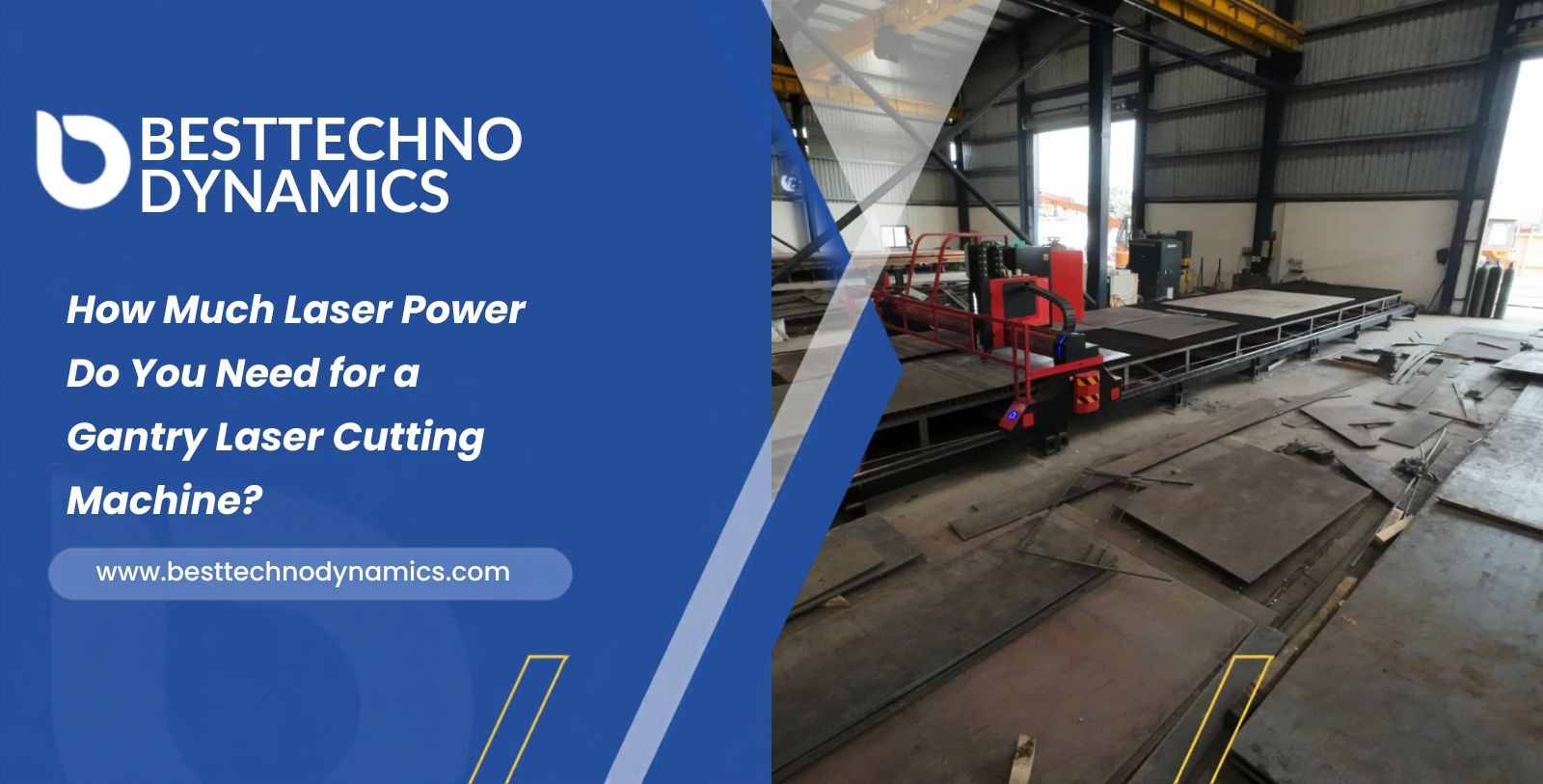
Why does laser power matter on a gantry machine?
The maximum that your machine can cut is determined by the laser power. A low-power source will be able to trim out thin sheets without problems but will be weaker and will stall on thicker plates. The more power you have, you will have a greater thickness range and quicker cutting speeds.
Power affects three things most directly:
- The thickness of the material the machine can slice through is called the maximum cutting thickness.
- The number of revolutions the head makes per minute.
- The smoothness, squareness, and lack of dross on a cut edge.
However, more power is not always better for every job. If the cut is too aggressive, very high power can leave a rough cut edge on a thin sheet unless power and speed are decreased and nozzle settings are adjusted.
How does power affect cutting speed and edge quality?
The combination of speed and power. If the speed is not adequate for the thickness, the operator is required to reduce the speed of the head, which will increase heat input and may increase the kerf width. The right power results in the beam cutting through in one pass, leaving a narrow, clean edge.
How does material type change power needs?
The second important factor is material. The amount of power needed will vary significantly depending on the metal reflectivity, absorption, and conductivity.
Mild steel requirements
Mild steel is the most easily cut material by a fiber laser. It absorbs the beam and can be used with oxygen assist (exothermic reaction which works to speed up cutting). Mild steel is a basic material for most job shops and is used to determine the size of a machine.
Stainless steel and aluminium requirements
Nitrogen is used to maintain the edge bright and free of oxides, and as a cutting operation generally requires more power than cutting mild steel of the same thickness, the same is true for stainless steel. Because nitrogen gas is not being added to the process to provide heat, it requires more energy to be used.
Moreover, aluminium is more challenging. It has a high reflectivity and good heat conductivity, requiring a higher peak power and careful parameter tuning. Sometimes, the buyer will relax the aluminium and opt for a more powerful source than what a mild-steel workload would demand.
Which power range matches your sheet thickness?
The table below gives approximate starting ranges for common thicknesses. Use these as parameters – not rules. This varies depending on speed, gas pressure, nozzle size, and the specific alloy.
| Material Thickness | Mild Steel (Oxygen) | Stainless Steel (Nitrogen) | Aluminium (Nitrogen) |
|---|---|---|---|
| Up to 3 mm | 1 kW – 1.5 kW | 1.5 kW – 2 kW | 1.5 kW – 2 kW |
| 3 mm – 6 mm | 2 kW – 3 kW | 2 kW – 3 kW | 2 kW – 4 kW |
| 6 mm – 10 mm | 3 kW – 4 kW | 3 kW – 4 kW | 4 kW – 6 kW |
| 10 mm – 16 mm | 4 kW – 6 kW | 6 kW – 8 kW | 6 kW – 8 kW |
| 16 mm – 25 mm | 6 kW – 12 kW | 8 kW – 12 kW | 10 kW and above |
Therefore, if you are thinking about taking a power level, check with the supplier for sample cuts in your own material. The best way to tell you more than any table can is to provide a sample run.
How do bed size and duty cycle affect your choice?
Factors other than power must also be considered in the decision. The correct machine will also depend on the physical size of your work and on the time you put in running it.
Choosing the right bed size
The standard gantry bed size is 3000 mm × 1500 mm, but in large formats like 4000 mm × 2000 mm, they are widely used in structural and fabrication projects. Larger beds require a more powerful drive and a stiffer frame, frequently to maintain throughput in larger beds.
Your commonly cut sizes and the requirement to minimise the offcut will be helpful to the gantry type laser cutting machine manufacturer in India to advise you on the size of the bed you require. Beds that are too big take up room and are more costly to operate; make the bed size to your actual jobs.
Duty cycle and production volume
Duty cycle is the number of hours that a machine can be operated every day before excessive wear. The needs of a shop that operates a few hours a day are vastly different from a shop that operates 2-3 shifts a day. More power is available in higher volume operations due to the speed of each part, which reduces the cost per part.
It's a line of thinking that is adopted by many companies in Gujarat's industrial clusters during capacity planning. Gujarat-based laser machine manufacturers frequently suggest the power based on the number of pieces that the shop will be producing per day, not necessarily on the most powerful job the shop may be getting once a year.
What role do assist gases play?
Helps the gas with the laser beam and affects the amount of power required. Selection of the proper gas can lead to power savings, dross reduction, and better edge finish.
- Oxygen: Speeds up the cutting rate of mild steel by exothermic reaction, creating an oxidised edge.
- Nitrogen: Bright and clean edges on stainless steel and aluminium; consumes more gas and power.
- Compressed air: A less expensive method for thin material where edge finish is not as important.
But changing gases is not an easy way to get around a lack of power. The pressure and nozzle specifications are different for each gas, so consult your supplier to determine the parameters for your gas mix.
How should you pick a reliable supplier?
If the machine is not built and supported properly, then choosing the right power is of no use. A good supplier assists you in sizing the system, conducts test cuts, and supplies training and spare parts.
Questions to ask before you buy
Before placing a purchase order, remember these factors:
- Will the supplier cut some trials on my type of material and thickness?
- What is its expected lifespan, and what is its warranty?
- What is the turnaround time for spares like nozzles, lenses, and windows?
- Can the software be set up, and does the price cover it?
When you begin to look for a Gantry Type Laser Cutting Machine manufacturer in India, you should get at least three quotes from them side by side so that you can compare their prices. Consider the build quality, control software, and after-sales support, rather than the headline price.
A lot of buyers also consider choices in the region. Laser machine manufacturers in Gujarat have been gaining momentum, which could lead to robust local engineering assistance and quicker turnaround times.
Working with local dealers and service support
When a machine stops mid-production, local service makes a difference. CNC laser machine dealers in Gujarat are likely to be able to do site visits quickly, carry standard spare parts, and answer operators’ questions. So, it is a good idea to check with one again how fast they can respond and how many technicians they have at their disposal.
Closing Line
The laser output of a gantry-type machine is determined by the material being cut, its thickness, cutting speed, bed size, and production hours. Start by examining the thickest material that is cut per week and then factor in some margin for growth. Use the table provided with this guide as your basis for deciding the power to use, but ensure that your conclusion is backed up by measurable tests.
A well-suited system is likely to reduce your production cost per unit and give you a consistent production run. Make sure to ask the gantry laser cutting machine manufacturer in India for a sample cut and to provide the service plan on paper before you place an order.
Frequently asked questions
1. Is a 1 kW Laser Enough for a Gantry Machine?
A 1 kW laser is capable of cutting mild steel plates of about 3 mm thickness. Higher power is required to cut through thicker plates.
2. Is Higher Laser Power Always Better?
No. Extra power adds to the cost of the laser system without helping with cutting thin sheets. The laser system should have enough power to handle normal activities.
3. Does Stainless Steel Need More Power Than Mild Steel?
Yes. In most cases, nitrous oxide cutting of stainless steel requires more power to achieve clean edges without oxides.
4. How Long Does a Fiber Laser Source Last?
Laser sources can work for thousands of hours, but the actual lifespan depends on usage conditions and the maintenance applied.